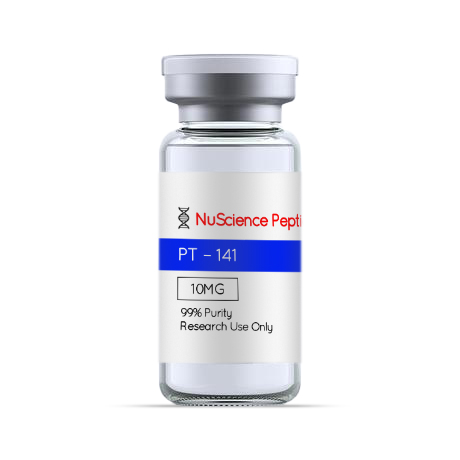
PT-141 Peptide (Bremelanotide)
This product is not intended for weight loss, human consumption, or veterinary use. It is sold for research purposes only. Please handle with care and follow all safety guidelines for the specific chemicals involved.
PT-141, also known as bremelanotide, is a synthetic PT-141 peptide classified as a non-selective agonist of melanocortin receptors, with primary activity at MC3R and MC4R. This research peptide has been widely examined in preclinical models to better understand melanocortin-mediated signaling pathways involved in sexual behavior and neuroendocrine regulation.
Preclinical investigations using rat models have been central to characterizing the pharmacodynamics of PT-141 – 10mg. In male rats, systemic exposure to PT-141 resulted in activation of hypothalamic neurons, as indicated by increased c-Fos immunoreactivity. This neural activation was associated with erectile responses, suggesting that PT-141 modulates centrally mediated melanocortin pathways rather than peripheral vascular mechanisms.
In female rat models, PT-141 selectively increased solicitational behaviors without altering lordosis reflexes or general locomotor activity. This distinction indicates that PT-141 may influence motivational aspects of sexual behavior rather than nonspecific arousal or motor stimulation. Such findings have positioned pt 141 as a compound of interest in research focused on central behavioral regulation.
Additional studies examining melanocortin receptor agonists support the role of PT-141 in modulating sexual behaviors across sexes through central nervous system pathways. The involvement of the melanocortin system highlights the relevance of PT-141 peptide in experimental research exploring neural control of sexual function.
Overall, animal studies have provided critical insight into how PT-141 influences central melanocortin signaling and associated behaviors. These findings support its continued use as a research peptide for investigating neurobehavioral mechanisms related to sexual motivation and response.
References
- Wessells, H., Hruby, V. J., Hackett, J., Han, G., Balse-Srinivasan, P., & Vanderah, T. W. (2003). PT-141: a melanocortin agonist for the treatment of sexual dysfunction. Neuroscience, 118(3), 755-762. https://pubmed.ncbi.nlm.nih.gov/12851303/
- Pfaus, J. G., Shadiack, A., Van Soest, T., Tse, M., & Molinoff, P. (2004). Selective facilitation of sexual solicitation in the female rat by a melanocortin receptor agonist. Proceedings of the National Academy of Sciences, 101(27), 10201-10204. https://pubmed.ncbi.nlm.nih.gov/15226502/
- Hadley, M. E., & Dorr, R. T. (2006). Melanocortins in the treatment of male and female sexual dysfunction. Current Topics in Medicinal Chemistry, 6(6), 603-608. https://pubmed.ncbi.nlm.nih.gov/17584134/
- Bremelanotide. (n.d.). In Wikipedia. Retrieved April 14, 2025, from https://en.wikipedia.org/wiki/Bremelanotide
- Melanocortin 4 receptor. (n.d.). In Wikipedia. Retrieved April 14, 2025, from https://en.wikipedia.org/wiki/Melanocortin_4_receptor
ALL LITERATURE, INFORMATION, AND DATA, PROVIDED ON THIS WEBSITE ARE FOR INFORMATIONAL AND EDUCATIONAL PURPOSES ONLY.
Properties
| Molecular Formula |
C50H68N14O10 |
|---|---|
| Molecular Weight | 1025.2 |
| Monoisotopic Mass | 1024.52428442 |
| Polar Area | 379 |
| Complexity | 1950 |
| XLogP | 0.7 |
| Heavy Atom Count | 74 |
| Hydrogen Bond Donor Count | 13 |
| Hydrogen Bond Acceptor Count | 12 |
| Rotatable Bond Count | 17 |
| Physical Appearance | Fine White Lyophilized Powder |
| Stability | Lyophilized protein is to be stored at -20°C. It is recommended to aliquot the reconstituted (dissolved) protein into several discrete vials in order to avoid repeated freezing and thawing. Reconstituted protein can be stored at 4°C |
| PubChem LCSS |
PT-141 (Bremelanotide) Laboratory Chemical Safety Summary |
Identifiers
| CID | 9941379 |
|---|---|
| CAS | 189691.06.3 |
| InChI | InChI=1S/C50H68N14O10/c1-3-4-16-35(58-29(2)65)43(67)64-41-25-42(66)54-20-11-10-18-37(49(73)74)60-46(70)39(23-31-26-56-34-17-9-8-15-33(31)34)62-44(68)36(19-12-21-55-50(51)52)59-45(69)38(22-30-13-6-5-7-14-30)61-47(71)40(63-48(41)72)24-32-27-53-28-57-32/h5-9, 13-15, 17, 26-28, 35-41, 56H, 3-4, 10-12, 16, 18-25H2, 1-2H3, (H, 53, 57)(H, 54, 66)(H, 58, 65)(H, 59, 69)(H, 60, 70)(H, 61, 71)(H, 62, 68)(H, 63, 72)(H, 64, 67)(H, 73, 74)(H4, 51, 52, 55)/t35-, 36-, 37-, 38+, 39-, 40-, 41-/m0/s1 |
| InChIKey | FFHBJDQSGDNCIV-MFVUMRCOSA-N |
| Isomeric SMILES | CCCC[C@@H](C(=O)N[C@H]1CC(=O)NCCCC[C@H](NC(=O)[C@@H](NC(=O)[C@@H](NC(=O)[C@H](NC(=O)[C@@H](NC1=O)CC2=CN=CN2)CC3=CC=CC=C3)CCCN=C(N)N)CC4=CNC5=CC=CC=C54)C(=O)O)NC(=O)C |
| Canonical SMILES | CCCCC(C(=O)NC1CC(=O)NCCCCC(NC(=O)C(NC(=O)C(NC(=O)C(NC(=O)C(NC1=O)CC2=CN=CN2)CC3=CC=CC=C3)CCCN=C(N)N)CC4=CNC5=CC=CC=C54)C(=O)O)NC(=O)C |
| IUPAC Name | (3S, 6S, 9R, 12S, 15S, 23S)-15-[[(2S)-2-acetamidohexanoyl]amino]-9-benzyl-6-[3-(diaminomethylideneamino)propyl]-12-(1H-imidazol-5-ylmethyl)-3-(1H-indol-3-ylmethyl)-2, 5, 8, 11, 14, 17-hexaoxo-1, 4, 7, 10, 13, 18-hexazacyclotricosane-23-carboxylic acid |
Related products