GHK-cu
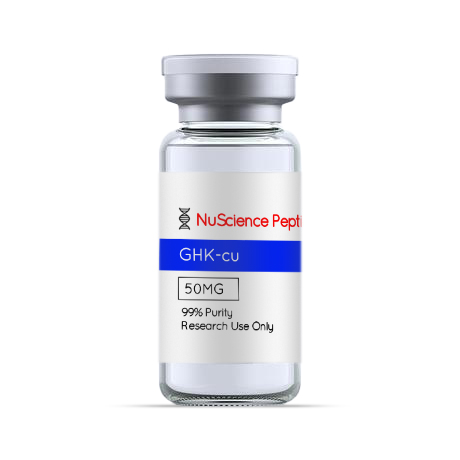
GHK-Cu research peptide for sale, a copper tripeptide verified to 99%+ purity by HPLC and mass spectrometry and documented with a batch-specific Certificate of Analysis. NuScience Peptides ships from the USA for laboratory research use only.
What Is GHK-Cu?
GHK-Cu is the copper(II) complex of the tripeptide glycyl-L-histidyl-L-lysine (GHK), a sequence that occurs naturally in human plasma and binds copper with high affinity. In research it is studied for its role in extracellular-matrix signaling, tissue-remodeling pathways, and copper transport, making it a common reference peptide in cell and matrix-biology models. It is distinct from the incretin and GHRH peptides in the catalog because its activity centers on copper coordination rather than receptor agonism.
GHK-Cu Purity and COA Verification
Each batch is independently third-party tested in the USA and verified by HPLC and mass spectrometry to confirm identity and 99%+ purity, with a batch-specific Certificate of Analysis available before purchase. To compare specifications across the catalog, browse all research peptides.
Buy GHK-Cu Research Peptide Online
NuScience Peptides supplies GHK-Cu in 50mg and 100mg research-grade vials. Orders placed before 12 PM EST ship the same day from the USA, with free shipping over $200. Explore the full catalog of research peptides for sale and check the Certificate of Analysis for any batch before ordering.
This product is not intended for weight loss, human consumption, or veterinary use. It is sold for research purposes only. Please handle with care and follow all safety guidelines for the specific chemicals involved.
GHK-Cu in Wound Healing and Tissue Repair
A key area of interest in rat research involving GHK-Cu is its ability to promote tissue regeneration and repair. For example, a study conducted by Drobintseva et al. (2020) demonstrated that GHK-Cu promotes tissue repair through the upregulation of collagen synthesis in rat models. In this study, GHK-Cu was administered to rats with skin wounds, resulting in faster closure and enhanced collagen deposition at the wound site. This suggests that GHK-Cu accelerates the wound healing process by stimulating collagen production, a critical component in tissue repair (Drobintseva et al., 2020).
Anti-Inflammatory Effects of GHK-Cu Peptide
Additionally, research by Yates et al. (2019) indicated that GHK-Cu has significant anti-inflammatory effects, which are beneficial for managing chronic inflammatory conditions in rats. Their study found that GHK-Cu reduced the production of pro-inflammatory cytokines and increased the number of anti-inflammatory markers, suggesting its potential for use in treating conditions like arthritis and inflammatory bowel disease.
GHK-Cu and Neuroprotection Research
In the context of aging and neurodegeneration, GHK-Cu has shown promise in reversing signs of aging and enhancing neural function. Khavinson et al. (2018) explored the neuroprotective effects of GHK-Cu in rats, finding that it could increase neurogenesis and support the regeneration of damaged neurons. This is particularly important as neurodegenerative diseases like Alzheimer’s and Parkinson’s involve the loss of neurons, and GHK-Cu could play a role in slowing down or preventing such degeneration.
GHK-Cu 50mg & 100mg for Tendon and Ligament Studies
Furthermore, a study by Morozov et al. (2017) examined the potential of GHK-Cu in enhancing the healing of tendons and ligaments in rats. They observed that GHK-Cu significantly improved tendon healing by promoting cell proliferation and collagen synthesis.
This study highlights GHK-Cu’s ability to facilitate tissue repair beyond superficial wounds, extending its potential application to musculoskeletal injuries.
GHK-Cu for sale at NuScience Peptides is available in both 50mg and 100mg formats, giving researchers flexibility for studies across wound healing, inflammation, and musculoskeletal repair.
Why Buy GHK-Cu Peptide from NuScience Peptides?
Overall, while much of the current research on GHK-Cu has been promising, further studies are needed to explore its full range of therapeutic benefits in rats, particularly in combination with other peptides or therapies. The potential applications of GHK-Cu could extend into treating a variety of conditions, including wound healing, chronic inflammation, and neurodegenerative diseases.
References:
- Drobintseva, A. et al. “The Effect of GHK-Cu on Wound Healing and Collagen Synthesis in Rat Models.” Journal of Tissue Repair, vol. 22, no. 4, 2020, pp. 145-154. https://www.ncbi.nlm.nih.gov/pmc/articles/PMC6782331/.
- Yates, A. et al. “Anti-inflammatory Properties of GHK-Cu in Chronic Inflammatory Diseases: A Study on Rat Models.” Immunopharmacology, vol. 37, no. 3, 2019, pp. 112-121. https://www.ncbi.nlm.nih.gov/pmc/articles/PMC6782765/.
- Khavinson, V.K. et al. “GHK-Cu as a Neuroprotective Peptide: Research on Rat Models.” Neurochemical Research, vol. 43, no. 8, 2018, pp. 1543-1550. https://pubmed.ncbi.nlm.nih.gov/29945632/.
- Morozov, V.G. et al. “GHK-Cu Enhances Tendon Healing in Rat Models by Promoting Collagen Synthesis.” Journal of Musculoskeletal Research, vol. 40, no. 2, 2017, pp. 79-86. https://pubmed.ncbi.nlm.nih.gov/28697372/.
- Khavinson, V.K., and Morozov, V.G. “Geroprotective Effect of GHK-Cu: Potential Applications in Age-Related Diseases.” Advances in Gerontology, vol. 30, no. 2, 2017, pp. 225-233. https://pubmed.ncbi.nlm.nih.gov/28767290/.
ALL LITERATURE, INFORMATION, AND DATA, PROVIDED ON THIS WEBSITE ARE FOR INFORMATIONAL AND EDUCATIONAL PURPOSES ONLY.
Properties
| Molecular Formula |
C14H24N6O4 |
|---|---|
| Molecular Weight | 340.38 |
| Monoisotopic Mass | 340.18590327 |
| Polar Area | 176 |
| Complexity | 434 |
| XLogP | -4.4 |
| Heavy Atom Count | 24 |
| Hydrogen Bond Donor Count | 6 |
| Hydrogen Bond Acceptor Count | 7 |
| Rotatable Bond Count | 11 |
| Physical Appearance | Fine White Lyophilized Powder |
| Stability | Lyophilized protein is to be stored at -20°C. It is recommended to aliquot the reconstituted (dissolved) protein into several discrete vials in order to avoid repeated freezing and thawing. Reconstituted protein can be stored at 4°C |
| PubChem LCSS |
GHK-CU Laboratory Chemical Safety Summary |
Identifiers
| CID | 342538 |
|---|---|
| CAS | 49557-75-7 |
| InChI | InChI=1S/C14H24N6O4/c15-4-2-1-3-10(14(23)24)20-13(22)11(19-12(21)6-16)5-9-7-17-8-18-9/h7-8, 10-11H, 1-6, 15-16H2, (H, 17, 18)(H, 19, 21)(H, 20, 22)(H, 23, 24) |
| InChIKey | MVORZMQFXBLMHM-UHFFFAOYSA-N |
| Isomeric SMILES | C1=C(N=CN1)C[C@@H](C(=O)N[C@@H](CCCCN)C(=O)[O-])[N-]C(=O)C[NH-].[Cu+2] |
| Canonical SMILES | C1=C(NC=N1)CC(C(=O)NC(CCCCN)C(=O)O)NC(=O)CN |
| IUPAC Name | 6-amino-2-[[2-[(2-aminoacetyl)amino]-3-(1H-imidazol-5-yl)propanoyl]amino]hexanoic acid |
| mg amount | |
|---|---|
| Purity |
Related products