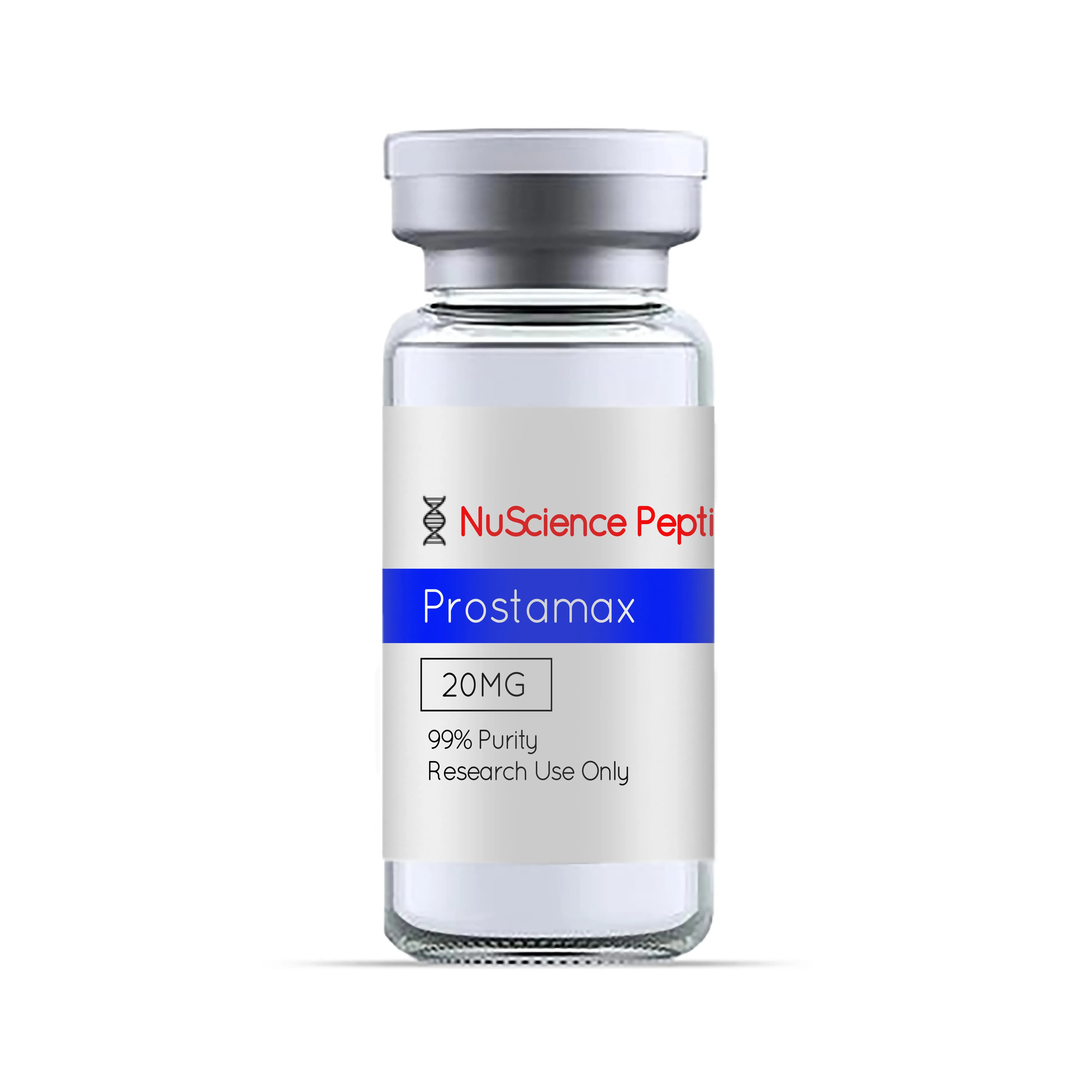
Prostamax Research in Laboratory Rats
This product is not intended for weight loss, human consumption, or veterinary use. It is sold for research purposes only. Please handle with care and follow all safety guidelines for the specific chemicals involved.
Prostate Tissue Bioregulation Research
Prostamax is a specialized peptide bioregulator derived from prostate tissue. Developed as part of the peptide therapy class originally pioneered by the Russian Institute of Bioregulation and Gerontology, researchers often buy Prostamax peptide to investigate its role in cellular protein synthesis and tissue-specific regulation within laboratory settings. Prostamax is composed of short peptide chains that act selectively on prostate tissue to support cellular function, regeneration, and immune modulation. It is primarily studied for its potential role in managing prostate disorders, such as benign prostatic hyperplasia (BPH), prostatitis, and age-related prostate dysfunction.
Experimental Observations in Animal Models
In laboratory rats, Prostamax has been shown to influence prostate health by modulating gene expression, reducing inflammatory markers, and stimulating the regeneration of epithelial tissue within the prostate gland. One study demonstrated that rats treated with Prostamax showed significant normalization of prostate gland structure and improved epithelial cell morphology compared to control groups. These findings suggest potential utility in age-related or hormone-induced prostatic changes [1].
Impact on Pro-Inflammatory Cytokines
Another study evaluating Prostamax in a model of chemically induced prostatitis revealed a marked decrease in pro-inflammatory cytokines such as IL-6 and TNF-alpha. This suggests that Prostamax may have anti-inflammatory properties that contribute to its therapeutic effect in chronic prostatitis and prostate tissue damage [2].
Cellular Proliferation and Fibrosis Regulation
Furthermore, Prostamax appears to exert a regulatory effect on apoptosis-related genes, helping to balance cell proliferation and programmed cell death. In aging rats, Prostamax improved prostate histological parameters and reduced fibrosis, suggesting a restorative effect on senescent tissue [3].
Research Standards and Availability
While the research in animal models is promising, further clinical trials are needed to establish its efficacy and safety in humans. Nonetheless, Prostamax holds potential as a therapeutic agent in managing prostate health through peptide-based regenerative approaches.
Technical Specifications
Each vial contains 20mg of high-purity product. For precise reconstitution protocols, researchers should consult our Peptide Handling and Storage guide. To broaden the scope of comparative studies, this compound is frequently investigated alongside other Bioregulator Peptides like Testagen.
References:
- Khavinson, V.K., et al. (2003). Peptide regulation of age-related changes in the prostate gland. Bulletin of Experimental Biology and Medicine, 136(7), 680–682. PubMed: 14635991
- Trofimova, S.V., et al. (2010). Effects of peptide bioregulators on experimental prostatitis in rats. Advances in Gerontology, 23(3), 432–437. PubMed: 21086525
- Khavinson, V.K., et al. (2012). Short peptides and prostate function in aging rats. Neuroendocrinology Letters, 33(6), 561–566. PubMed: 23391984
ALL LITERATURE, INFORMATION, AND DATA, PROVIDED ON THIS WEBSITE ARE FOR INFORMATIONAL AND EDUCATIONAL PURPOSES ONLY.
Properties
| Molecular Formula |
|---|
| Molecular Weight |
| Monoisotopic Mass |
| Polar Area |
| Complexity |
| XLogP |
| Heavy Atom Count |
| Hydrogen Bond Donor Count |
| Hydrogen Bond Acceptor Count |
| Rotatable Bond Count |
| Physical Appearance |
| Stability |
| PubChem LCSS |
Identifiers
| CID |
|---|
| CAS |
| InChI |
| InChIKey |
| Isomeric SMILES |
| Canonical SMILES |
| IUPAC Name |
Related products