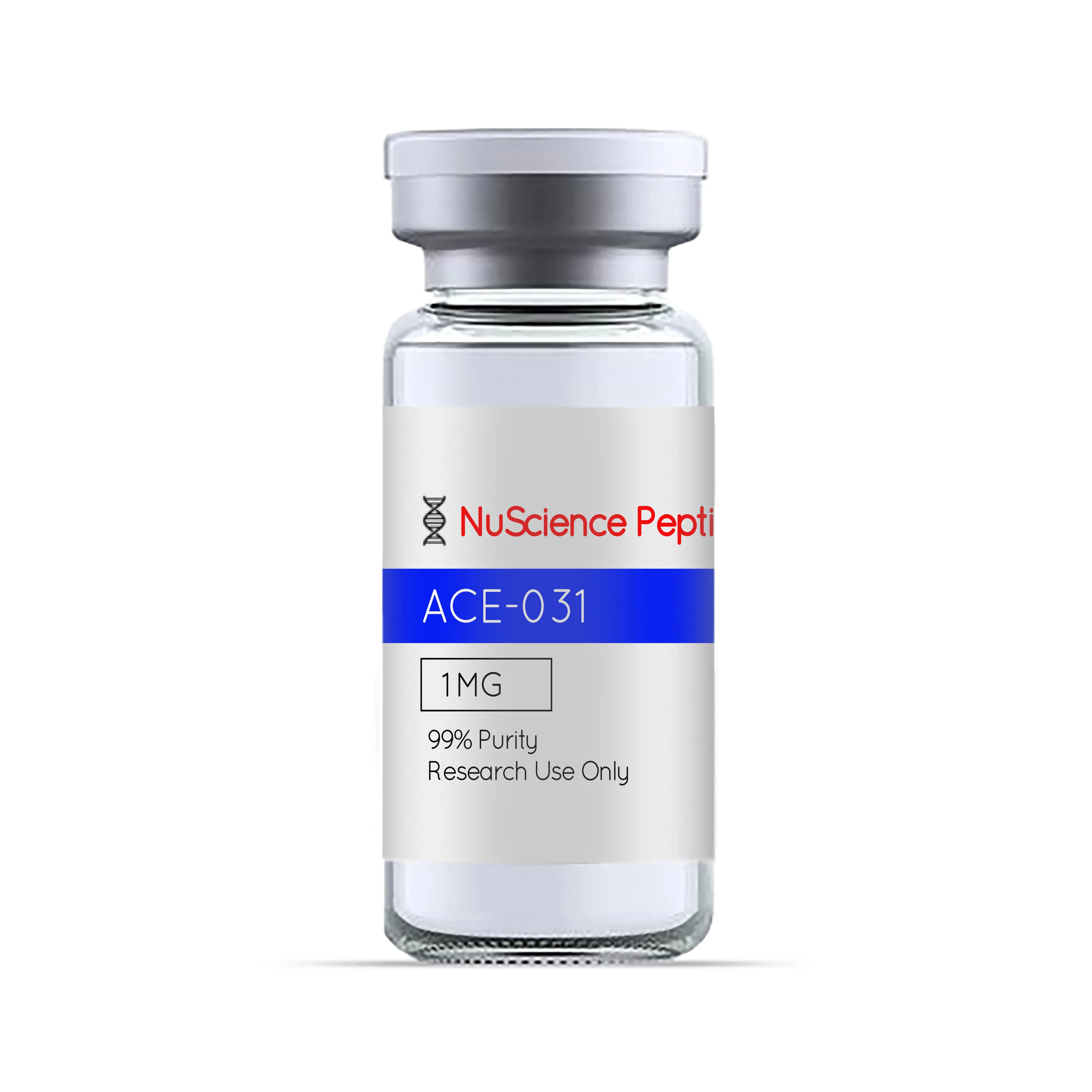
ACE-031
This product is not intended for weight loss, human consumption, or veterinary use. It is sold for research purposes only. Please handle with care and follow all safety guidelines for the specific chemicals involved.
What Is ACE-031 Peptide?
ACE-031, a recombinant fusion protein designed to inhibit myostatin and related ligands, has garnered attention for its potential to enhance muscle mass and strength. Myostatin, a member of the transforming growth factor-beta (TGF-β) superfamily, negatively regulates muscle growth. By binding to activin type II receptors, myostatin initiates signaling pathways that suppress muscle differentiation and growth. Inhibiting this pathway with ACE-031 can, therefore, promote muscle hypertrophy.(Wikipedia)
ACE-031 Peptide Benefits in Muscle Hypertrophy Research
In a study examining the effects of ACE-031 on suboccipital musculature in rats, a 16-week administration of the inhibitor led to significant muscle hyperplasia. This muscular activation was associated with increased intracranial pressure, suggesting a functional role of the myodural bridge in cerebrospinal fluid dynamics. The findings underscore the systemic effects of localized muscle growth and the importance of understanding the broader physiological implications of myostatin inhibition. (PubMed)
Further research into myostatin and its inhibitors has demonstrated that blocking this pathway can lead to substantial increases in muscle mass. For instance, a study involving mice treated with a soluble activin type IIB receptor, which functions similarly to ACE-031, showed muscle mass increases of up to 60%. These results highlight the potent anabolic effects of myostatin inhibition and its potential therapeutic applications. (Wikipedia)
ACE-031: Therapeutic Potential Beyond Muscle Growth
The therapeutic potential of ACE-031 extends beyond muscle hypertrophy. By promoting muscle growth, ACE-031 may offer benefits in conditions characterized by muscle wasting, such as muscular dystrophy or age-related sarcopenia. However, the systemic effects observed in studies, such as alterations in intracranial pressure, emphasize the need for comprehensive evaluations of safety and efficacy in long-term applications.
ACE-031 Peptide: Myostatin Inhibition and Future Research
In conclusion, ACE-031 represents a promising avenue for enhancing muscle mass through myostatin inhibition. While preclinical studies in rats have demonstrated significant muscle growth, further research is essential to fully understand the systemic effects and therapeutic potential of this intervention. Buy ACE-031 from NuScience Peptides to advance your research into myostatin inhibition, muscle hypertrophy, and related metabolic pathways. Explore related compounds including Follistatin 344 for myostatin antagonism studies and IGF-1 LR3 for growth factor comparison.(Wikipedia)
References
- Zhang, Y., et al. “The relationship between myodural bridges, hyperplasia of suboccipital musculature, and cerebrospinal fluid dynamics.” PubMed, 2022. https://pubmed.ncbi.nlm.nih.gov/36054096/(PubMed)
- “Myostatin.” Wikipedia, 2025. https://en.wikipedia.org/wiki/Myostatin(Wikipedia)
- Nakamura, R., et al. “Adrenomedullin administration immediately after myocardial infarction ameliorates progression of heart failure in rats.” Circulation, 2004. https://pubmed.ncbi.nlm.nih.gov/15262849/(PubMed)
- Zimmermann, R., et al. “Effect of long-term ACE inhibition on myocardial tissue in hypertensive stroke-prone rats.” Journal of Molecular and Cellular Cardiology, 1999. https://pubmed.ncbi.nlm.nih.gov/10423343/(PubMed)
- Lavrentyev, E. N., & Malik, K. U. “High glucose-induced Nox1-derived superoxides downregulate PKC-betaII, which subsequently decreases ACE2 expression and ANG(1-7) formation in rat VSMCs.” American Journal of Physiology-Heart and Circulatory Physiology, 2009. https://pubmed.ncbi.nlm.nih.gov/18978194/(PubMed)
ACE 031 injectable for sale at NuScience Peptides is supported by the peer-reviewed research referenced above, ensuring researchers can explore myostatin inhibition with confidence.
ALL LITERATURE, INFORMATION, AND DATA, PROVIDED ON THIS WEBSITE ARE FOR INFORMATIONAL AND EDUCATIONAL PURPOSES ONLY.
Properties
| Molecular Formula |
C133H227N43O33 |
|---|---|
| Molecular Weight | 2956.5 g/mol |
| Monoisotopic Mass | |
| Polar Area | |
| Complexity | 6600 |
| XLogP | -8.1 |
| Heavy Atom Count | |
| Hydrogen Bond Donor Count | 48 |
| Hydrogen Bond Acceptor Count | 40 |
| Rotatable Bond Count | 107 |
| Physical Appearance | Fine White Lyophilized Powder |
| Stability | |
| PubChem LCSS |
PubChem LCSS |
Identifiers
| CID | 118732224 |
|---|---|
| CAS | 1621169-52-5 |
| InChI | InChI=1S/C133H227N43O33/c1-18-68(11)101(125(205)160-81(35-25-27-51-135)115(195)173-102(69(12)19-2)126(206)162-87(45-48-98(138)182)117(197)175-104(71(14)21-4)128(208)169-91(58-67(9)10)119(199)170-95(63-177)123(203)157-80(34-24-26-50-134)112(192)166-90(57-66(7)8)118(198)155-83(37-29-53-150-131(143)144)111(191)164-89(106(140)186)56-65(5)6)172-108(188)73(16)154-109(189)88(46-49-100(184)185)163-127(207)103(70(13)20-3)174-116(196)85(39-31-55-152-133(147)148)158-124(204)96(64-178)171-120(200)92(59-75-40-42-77(180)43-41-75)167-113(193)84(38-30-54-151-132(145)146)161-129(209)105(74(17)179)176-122(202)94(61-99(139)183)168-114(194)86(44-47-97(137)181)159-110(190)82(36-28-52-149-130(141)142)156-121(201)93(165-107(187)72(15)136)60-76-62-153-79-33-23-22-32-78(76)79/h22-23,32-33,40-43,62,65-74,80-96,101-105,153,177-180H,18-21,24-31,34-39,44-61,63-64,134-136H2,1-17H3,(H2,137,181)(H2,138,182)(H2,139,183)(H2,140,186)(H,154,189)(H,155,198)(H,156,201)(H,157,203)(H,158,204)(H,159,190)(H,160,205)(H,161,209)(H,162,206)(H,163,207)(H,164,191)(H,165,187)(H,166,192)(H,167,193)(H,168,194)(H,169,208)(H,170,199)(H,171,200)(H,172,188)(H,173,195)(H,174,196)(H,175,197)(H,176,202)(H,184,185)(H4,141,142,149)(H4,143,144,150)(H4,145,146,151)(H4,147,148,152)/t68-,69-,70-,71-,72-,73-,74+,80-,81-,82-,83-,84-,85-,86-,87-,88-,89-,90-,91-,92-,93-,94-,95-,96-,101-,102-,103-,104-,105-/m0/s1 |
| InChIKey | HXWLNPUQPASIHW-OOXKGWPCSA-N |
| Isomeric SMILES | |
| Canonical SMILES | CC[C@H](C)[C@@H](C(=O)N[C@@H](CCCCN)C(=O)N[C@@H]([C@@H](C)CC)C(=O)N[C@@H](CCC(=O)N)C(=O)N[C@@H]([C@@H](C)CC)C(=O)N[C@@H](CC(C)C)C(=O)N[C@@H](CO)C(=O)N[C@@H](CCCCN)C(=O)N[C@@H](CC(C)C)C(=O)N[C@@H](CCCNC(=N)N)C(=O)N[C@@H](CC(C)C)C(=O)N)NC(=O)[C@H](C)NC(=O)[C@H](CCC(=O)O)NC(=O)[C@H]([C@@H](C)CC)NC(=O)[C@H](CCCNC(=N)N)NC(=O)[C@H](CO)NC(=O)[C@H](CC1=CC=C(C=C1)O)NC(=O)[C@H](CCCNC(=N)N)NC(=O)[C@H]([C@@H](C)O)NC(=O)[C@H](CC(=O)N)NC(=O)[C@H](CCC(=O)N)NC(=O)[C@H](CCCNC(=N)N)NC(=O)[C@H](CC2=CNC3=CC=CC=C32)NC(=O)[C@H](C)N |
| IUPAC Name | (4S)-5-[[(2S)-1-[[(2S,3S)-1-[[(2S)-6-amino-1-[[(2S,3S)-1-[[(2S)-5-amino-1-[[(2S,3S)-1-[[(2S)-1-[[(2S)-1-[[(2S)-6-amino-1-[[(2S)-1-[[(2S)-1-[[(2S)-1-amino-4-methyl-1-oxopentan-2-yl]amino]-5-carbamimidamido-1-oxopentan-2-yl]amino]-4-methyl-1-oxopentan-2-yl]amino]-1-oxohexan-2-yl]amino]-3-hydroxy-1-oxopropan-2-yl]amino]-4-methyl-1-oxopentan-2-yl]amino]-3-methyl-1-oxopentan-2-yl]amino]-1,5-dioxopentan-2-yl]amino]-3-methyl-1-oxopentan-2-yl]amino]-1-oxohexan-2-yl]amino]-3-methyl-1-oxopentan-2-yl]amino]-1-oxopropan-2-yl]amino]-4-[[(2S,3S)-2-[[(2S)-2-[[(2S)-2-[[(2S)-2-[[(2S)-2-[[(2S,3R)-2-[[(2S)-4-amino-2-[[(2S)-5-amino-2-[[(2S)-2-[[(2S)-2-[[(2S)-2-aminopropanoyl]amino]-3-(1H-indol-3-yl)propanoyl]amino]-5-carbamimidamidopentanoyl]amino]-5-oxopentanoyl]amino]-4-oxobutanoyl]amino]-3-hydroxybutanoyl]amino]-5-carbamimidamidopentanoyl]amino]-3-(4-hydroxyphenyl)propanoyl]amino]-3-hydroxypropanoyl]amino]-5-carbamimidamidopentanoyl]amino]-3-methylpentanoyl]amino]-5-oxopentanoic acid |
Related products