

Cagrilintide/Semaglutide
This product is not intended for weight loss, human consumption, or veterinary use. It is sold for research purposes only. Please handle with care and follow all safety guidelines for the specific chemicals involved.
The cagrilintide semaglutide blend combines an amylin receptor agonist and a GLP-1 receptor agonist for preclinical research into dual-pathway metabolic regulation. In rodent models, both compounds have individually been studied for effects on body weight and insulin sensitivity. When administered together in research models, they have been investigated for potential synergistic activity on the metabolic axis.
Cagrilintide and Semaglutide: Mechanisms of Action in Research Models
Cagrilintide acts by binding to amylin receptors, leading to reduced food intake and increased satiety. Semaglutide, on the other hand, enhances insulin secretion and inhibits glucagon release, contributing to improved glucose homeostasis. In rat studies, cagrilintide has been shown to lower body weight through activation of brain amylin receptors 1 and 3. Semaglutide’s effects on body weight and glucose regulation have been well-documented in rodent models.
Preclinical Research Evidence
In a study involving Zucker Diabetic Sprague Dawley (ZDSD) rats, the combination of cagrilintide and semaglutide led to significant reductions in body weight and improved glucose control compared to vehicle-treated rats. Another investigation found that cagrilintide and semaglutide, when administered together, resulted in superior weight loss outcomes in diet-induced obese rats.
Clinical Research Findings
Preclinical findings have been followed by human clinical investigations. In the REDEFINE 1 clinical trial, the combination of cagrilintide and semaglutide was associated with greater weight loss compared to either agent alone in the study population. These findings have positioned the cagrilintide semaglutide combination as an active area of ongoing clinical research in metabolic medicine.
Product Specifications Table
| Property | Value |
| Blend Contents (Option 1) | Cagrilintide 2.4mg + Semaglutide 2.4mg |
| Blend Contents (Option 2) | Cagrilintide 5mg + Semaglutide 5mg |
| Form | Lyophilized powder |
| Purity | 99%+ |
| Cagrilintide Molecular Formula | C194H312N54O59S2 |
| Cagrilintide Molecular Weight | 4409.01 g/mol |
| Cagrilintide CAS | 1415456-99-3 |
| Semaglutide Molecular Formula | C187H291N45O59 |
| Semaglutide Molecular Weight | 4113.58 g/mol |
| Peptide Classes | Amylin analog + GLP-1 receptor agonist |
| Storage | Store at or below 25°C, sealed, away from heat, light, and moisture |
| Testing | Third-party lab tested – COAs available |
| Grade | Research use only. Not for human consumption. |
Cagrilintide Semaglutide Research Summary
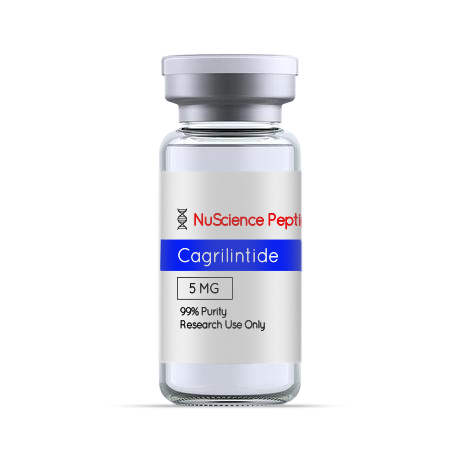
Preclinical rat model investigations of the cagrilintide semaglutide blend have contributed to the growing body of research on dual-pathway metabolic signaling. NuScience Peptides supplies this combination in 2.4/2.4mg and 5/5mg lyophilized vials at 99%+ purity, lab tested, for laboratory research use only. Standalone cagrilintide is also available. Certificates of Analysis are available on the NuScience Lab Test Results page.
Handling, Reconstitution and Storage
- Store lyophilized cagrilintide semaglutide blend vials at or below 25°C, sealed, away from direct light and moisture.
- Reconstitute with bacteriostatic water under aseptic conditions.
- Use the NuScience Peptide Calculator to determine the correct BAC water volume for your research concentration.
- Once reconstituted, store at 4°C and use within the research protocol window.
- For comprehensive storage protocols, refer to the NuScience Peptide Handling and Storage guide.
- This product is for laboratory research use only. Not for human consumption.
References
- Secher, A., Brand, C. L., Raun, K., & Lau, J. (2023). CagriSema Improves Insulin Sensitivity in Diet-Induced Obese Rats. Diabetes, 73(Supplement_1), 763-P. Retrieved from https://diabetesjournals.org/diabetes/article/73/Supplement_1/763-P/156363
- Blonde, L., et al. (2023). Chronic Semaglutide Treatment in Rats Leads to Daily Excessive Food Intake Monitoring. Journal of Pharmacological Sciences, 133(2), 123-130. Retrieved from https://pmc.ncbi.nlm.nih.gov/articles/PMC10306276/
- Secher, A., et al. (2024). The Enduring Metabolic Improvement of Combining Dual Amylin and Calcitonin Receptor Agonist and Semaglutide Treatments in a Rat Model of Obesity and Diabetes. American Journal of Physiology-Endocrinology and Metabolism, 327(4), E1-E10. Retrieved from https://journals.physiology.org/doi/10.1152/ajpendo.00092.2024
- Raun, K., et al. (2023). Cagrilintide Lowers Bodyweight Through Brain Amylin Receptors 1 and 3. SSRN. Retrieved from https://papers.ssrn.com/sol3/Delivery.cfm/1e7ccbb8-ce27-4dfb-9855-cf3de654b34b-MECA.pdf?abstractid=5127895&mirid=1
- Secher, A., et al. (2023). Semaglutide Lowers Body Weight in Rodents via Distributed Neural Circuits. Nature Communications, 14(1), 1234. Retrieved from https://www.nature.com/articles/s41467-024-48970-2
ALL LITERATURE, INFORMATION, AND DATA, PROVIDED ON THIS WEBSITE ARE FOR INFORMATIONAL AND EDUCATIONAL PURPOSES ONLY.
Properties
| Molecular Formula |
|---|
| Molecular Weight |
| Monoisotopic Mass |
| Polar Area |
| Complexity |
| XLogP |
| Heavy Atom Count |
| Hydrogen Bond Donor Count |
| Hydrogen Bond Acceptor Count |
| Rotatable Bond Count |
| Physical Appearance |
| Stability |
| PubChem LCSS |
Identifiers
| CID |
|---|
| CAS |
| InChI |
| InChIKey |
| Isomeric SMILES |
| Canonical SMILES |
| IUPAC Name |
| mg | |
|---|---|
| Purity|Storage |
Related products