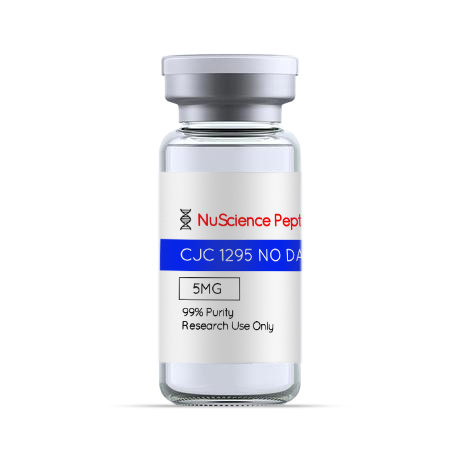

CJC-1295 NO-DAC
This product is not intended for weight loss, human consumption, or veterinary use. It is sold for research purposes only. Please handle with care and follow all safety guidelines for the specific chemicals involved.
CJC-1295 No DAC vs CJC-1295 with DAC Comparison
| Feature | CJC-1295 No DAC (Mod GRF 1-29) | CJC-1295 with DAC |
| Also known as | Mod GRF 1-29, Modified GRF 1-29 | CJC-1295, DAC-GRF |
| Drug Affinity Complex (DAC) | No | Yes |
| Amino acids | 29 | 30 (with DAC modification) |
| Approximate half-life in models | ~30 minutes (shorter) | Several days (extended) |
| GH pulse pattern | Preserves natural pulsatile pattern | Sustained continuous elevation |
| Common research use | Pulsatile GH release studies | Extended GH elevation studies |
| Available at NuScience | Yes – 5mg and 10mg | Yes |
Handling, Reconstitution and Storage
- Store lyophilized CJC-1295 No DAC vials at -20C until use
- Reconstitute with bacteriostatic water under aseptic conditions
- Use the NuScience Peptide Calculator to determine the correct BAC water volume for your research concentration
- Once reconstituted, store at 4C and use within the research protocol window
- For comprehensive storage protocols, refer to the NuScience Peptide Handling and Storage guide
- This product is for laboratory research use only. Not for human consumption.
References:
- Ionescu, M., & Frohman, L. A. (2006). Pulsatile secretion of growth hormone (GH) persists during continuous stimulation by CJC-1295, a long-acting GH-releasing hormone analog. The Journal of Clinical Endocrinology & Metabolism, 91(12), 4792–4797. https://pubmed.ncbi.nlm.nih.gov/17018654/
- Teichman, S. L., Neale, A., Lawrence, B., Gagnon, C., Castaigne, J. P., & Frohman, L. A. (2006). Prolonged stimulation of growth hormone (GH) and insulin-like growth factor I secretion by CJC-1295, a long-acting analog of GH-releasing hormone, in healthy adults. The Journal of Clinical Endocrinology & Metabolism, 91(3), 799–805. https://pubmed.ncbi.nlm.nih.gov/16352683/
- Alba, M., Fintini, D., Sagazio, A., Lawrence, B., Castaigne, J. P., Frohman, L. A., & Salvatori, R. (2006). Once-daily administration of CJC-1295, a long-acting growth hormone-releasing hormone (GHRH) analog, normalizes growth in the GHRH knockout mouse. American Journal of Physiology-Endocrinology and Metabolism, 291(6), E1290–E1294. https://pubmed.ncbi.nlm.nih.gov/16822960/
- Lapierre, H., Bonin, A., & Dubuc, J. (2005). Human growth hormone-releasing factor (hGRF)1-29-albumin bioconjugates activate the GRF receptor on the anterior pituitary in rats: identification of CJC-1295 as a long-lasting GRF analog. Endocrinology, 146(7), 3052–3058. https://pubmed.ncbi.nlm.nih.gov/15817669/
ALL LITERATURE, INFORMATION, AND DATA, PROVIDED ON THIS WEBSITE ARE FOR INFORMATIONAL AND EDUCATIONAL PURPOSES ONLY.
Properties
| Molecular Formula |
C152H252N44O42 |
|---|---|
| Molecular Weight | 3367.9 |
| Monoisotopic Mass | 3365.8935782 |
| Polar Area | 1450 |
| Complexity | 7710 |
| XLogP | -10.7 |
| Heavy Atom Count | 238 |
| Hydrogen Bond Donor Count | 52 |
| Hydrogen Bond Acceptor Count | 48 |
| Rotatable Bond Count | 118 |
| Physical Appearance | Fine White Lyophilized Powder |
| Stability | Lyophilized protein is to be stored at -20°C. It is recommended to aliquot the reconstituted (dissolved) protein into several discrete vials in order to avoid repeated freezing and thawing. Reconstituted protein can be stored at 4°C |
| PubChem LCSS |
CJC-1295 NO-DAC (MOD GRF 1-29) Laboratory Chemical Safety Summary |
Identifiers
| CID | 56841945 |
|---|---|
| CAS | 446262-90-4 |
| InChI | InChI=1S/C152H252N44O42/c1-22-79(15)118(194-125(214)84(20)171-135(224)107(68-115(206)207)181-124(213)81(17)169-126(215)91(155)65-87-41-45-89(201)46-42-87)147(236)189-106(66-86-34-25-24-26-35-86)141(230)196-120(85(21)200)149(238)180-99(51-54-114(158)205)132(221)190-111(72-199)145(234)185-105(67-88-43-47-90(202)48-44-88)140(229)178-96(40-33-59-168-152(164)165)128(217)177-94(37-28-30-56-154)133(222)193-117(78(13)14)146(235)187-100(60-73(3)4)134(223)170-82(18)123(212)175-97(49-52-112(156)203)130(219)183-103(63-76(9)10)138(227)191-109(70-197)143(232)172-83(19)122(211)174-95(39-32-58-167-151(162)163)127(216)176-93(36-27-29-55-153)129(218)182-102(62-75(7)8)137(226)184-101(61-74(5)6)136(225)179-98(50-53-113(157)204)131(220)186-108(69-116(208)209)142(231)195-119(80(16)23-2)148(237)188-104(64-77(11)12)139(228)192-110(71-198)144(233)173-92(121(159)210)38-31-57-166-150(160)161/h24-26, 34-35, 41-48, 73-85, 91-111, 117-120, 197-202H, 22-23, 27-33, 36-40, 49-72, 153-155H2, 1-21H3, (H2, 156, 203)(H2, 157, 204)(H2, 158, 205)(H2, 159, 210)(H, 169, 215)(H, 170, 223)(H, 171, 224)(H, 172, 232)(H, 173, 233)(H, 174, 211)(H, 175, 212)(H, 176, 216)(H, 177, 217)(H, 178, 229)(H, 179, 225)(H, 180, 238)(H, 181, 213)(H, 182, 218)(H, 183, 219)(H, 184, 226)(H, 185, 234)(H, 186, 220)(H, 187, 235)(H, 188, 237)(H, 189, 236)(H, 190, 221)(H, 191, 227)(H, 192, 228)(H, 193, 222)(H, 194, 214)(H, 195, 231)(H, 196, 230)(H, 206, 207)(H, 208, 209)(H4, 160, 161, 166)(H4, 162, 163, 167)(H4, 164, 165, 168)/t79-, 80-, 81+, 82-, 83-, 84-, 85+, 91-, 92-, 93-, 94-, 95-, 96-, 97-, 98-, 99-, 100-, 101-, 102-, 103-, 104-, 105-, 106-, 107-, 108-, 109-, 110-, 111-, 117-, 118-, 119-, 120-/m0/s1 |
| InChIKey | XOZMWINMZMMOBR-HRDSVTNWSA-N |
| Isomeric SMILES | CC[C@H](C)[C@@H](C(=O)N[C@@H](CC1=CC=CC=C1)C(=O)N[C@@H]([C@@H](C)O)C(=O)N[C@@H](CCC(=O)N)C(=O)N[C@@H](CO)C(=O)N[C@@H](CC2=CC=C(C=C2)O)C(=O)N[C@@H](CCCNC(=N)N)C(=O)N[C@@H](CCCCN)C(=O)N[C@@H](C(C)C)C(=O)N[C@@H](CC(C)C)C(=O)N[C@@H](C)C(=O)N[C@@H](CCC(=O)N)C(=O)N[C@@H](CC(C)C)C(=O)N[C@@H](CO)C(=O)N[C@@H](C)C(=O)N[C@@H](CCCNC(=N)N)C(=O)N[C@@H](CCCCN)C(=O)N[C@@H](CC(C)C)C(=O)N[C@@H](CC(C)C)C(=O)N[C@@H](CCC(=O)N)C(=O)N[C@@H](CC(=O)O)C(=O)N[C@@H]([C@@H](C)CC)C(=O)N[C@@H](CC(C)C)C(=O)N[C@@H](CO)C(=O)N[C@@H](CCCNC(=N)N)C(=O)N)NC(=O)[C@H](C)NC(=O)[C@H](CC(=O)O)NC(=O)[C@@H](C)NC(=O)[C@H](CC3=CC=C(C=C3)O)N |
| Canonical SMILES | CCC(C)C(C(=O)NC(CC1=CC=CC=C1)C(=O)NC(C(C)O)C(=O)NC(CCC(=O)N)C(=O)NC(CO)C(=O)NC(CC2=CC=C(C=C2)O)C(=O)NC(CCCNC(=N)N)C(=O)NC(CCCCN)C(=O)NC(C(C)C)C(=O)NC(CC(C)C)C(=O)NC(C)C(=O)NC(CCC(=O)N)C(=O)NC(CC(C)C)C(=O)NC(CO)C(=O)NC(C)C(=O)NC(CCCNC(=N)N)C(=O)NC(CCCCN)C(=O)NC(CC(C)C)C(=O)NC(CC(C)C)C(=O)NC(CCC(=O)N)C(=O)NC(CC(=O)O)C(=O)NC(C(C)CC)C(=O)NC(CC(C)C)C(=O)NC(CO)C(=O)NC(CCCNC(=N)N)C(=O)N)NC(=O)C(C)NC(=O)C(CC(=O)O)NC(=O)C(C)NC(=O)C(CC3=CC=C(C=C3)O)N |
| IUPAC Name | (3S)-4-[[(2S)-1-[[(2S, 3S)-1-[[(2S)-1-[[(2S, 3R)-1-[[(2S)-5-amino-1-[[(2S)-1-[[(2S)-1-[[(2S)-1-[[(2S)-6-amino-1-[[(2S)-1-[[(2S)-1-[[(2S)-1-[[(2S)-5-amino-1-[[(2S)-1-[[(2S)-1-[[(2S)-1-[[(2S)-1-[[(2S)-6-amino-1-[[(2S)-1-[[(2S)-1-[[(2S)-5-amino-1-[[(2S)-1-[[(2S, 3S)-1-[[(2S)-1-[[(2S)-1-[[(2S)-1-amino-5-carbamimidamido-1-oxopentan-2-yl]amino]-3-hydroxy-1-oxopropan-2-yl]amino]-4-methyl-1-oxopentan-2-yl]amino]-3-methyl-1-oxopentan-2-yl]amino]-3-carboxy-1-oxopropan-2-yl]amino]-1, 5-dioxopentan-2-yl]amino]-4-methyl-1-oxopentan-2-yl]amino]-4-methyl-1-oxopentan-2-yl]amino]-1-oxohexan-2-yl]amino]-5-carbamimidamido-1-oxopentan-2-yl]amino]-1-oxopropan-2-yl]amino]-3-hydroxy-1-oxopropan-2-yl]amino]-4-methyl-1-oxopentan-2-yl]amino]-1, 5-dioxopentan-2-yl]amino]-1-oxopropan-2-yl]amino]-4-methyl-1-oxopentan-2-yl]amino]-3-methyl-1-oxobutan-2-yl]amino]-1-oxohexan-2-yl]amino]-5-carbamimidamido-1-oxopentan-2-yl]amino]-3-(4-hydroxyphenyl)-1-oxopropan-2-yl]amino]-3-hydroxy-1-oxopropan-2-yl]amino]-1, 5-dioxopentan-2-yl]amino]-3-hydroxy-1-oxobutan-2-yl]amino]-1-oxo-3-phenylpropan-2-yl]amino]-3-methyl-1-oxopentan-2-yl]amino]-1-oxopropan-2-yl]amino]-3-[[(2R)-2-[[(2S)-2-amino-3-(4-hydroxyphenyl)propanoyl]amino]propanoyl]amino]-4-oxobutanoic acid |
| mg | |
|---|---|
| Storage |
Related products
Price range: $69.99 through $154.99
This product has multiple variants. The options may be chosen on the product page