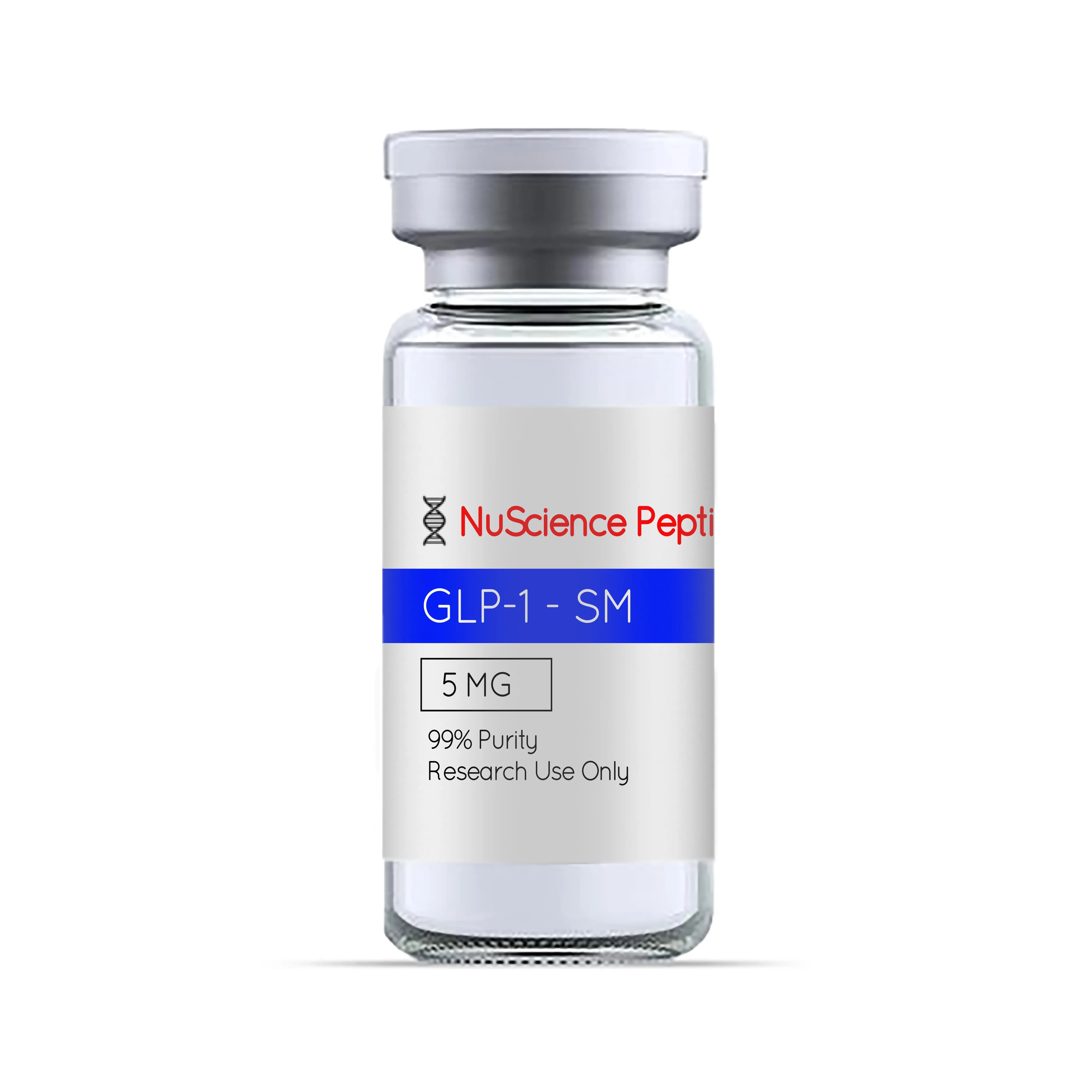

GLP-1 SM
GLP-1 research peptide for sale at 99%+ purity, verified by HPLC and mass spectrometry with a batch-specific Certificate of Analysis you can review before you buy. Supplied by NuScience Peptides in the USA for laboratory and analytical research use only.
What Is GLP-1?
GLP-1 is a synthetic glucagon-like peptide-1 (GLP-1) receptor agonist, a modified analog of the native human GLP-1 sequence. Structural changes, including an aminoisobutyric acid substitution and a C18 fatty-diacid chain, extend its half-life relative to native GLP-1, which is why it is widely used as a long-acting reference compound in incretin and glucose-regulation research. In laboratory study it is used to probe GLP-1 receptor signaling and related metabolic pathways.
GLP-1 Purity and COA Verification
Each batch is independently third-party tested in the USA and verified by HPLC and mass spectrometry to confirm identity and 99%+ purity, with a batch-specific Certificate of Analysis published for every lot. To compare specifications across the catalog, browse all research peptides.
Buy GLP-1 (Semaglutide) Research Peptide Online
NuScience Peptides supplies GLP-1 in multiple vial sizes for laboratory use. Orders placed before 12 PM EST ship the same day from the USA, with free shipping over $200. For the full range of research peptides for sale, check the Certificate of Analysis for any batch before you order.
Research chemicals are chemical substances used by scientists for medical and scientific research purposes. One characteristic of a research chemical is that it is for laboratory research use only. A research chemical is not intended for human or veterinary use. This distinction is required on the labels of research chemicals, and is what exempts them from regulation under Parts 100-740, Code of Federal Regulations Title 21 (21 CFR Parts 100-740).
NuScience Peptides sells research products only, they are not for human consumption.
ALL LITERATURE, INFORMATION, AND DATA, PROVIDED ON THIS WEBSITE ARE FOR INFORMATIONAL AND EDUCATIONAL PURPOSES ONLY.
Properties
| Molecular Formula |
C187H291N45O59 |
|---|---|
| Molecular Weight | 4114 |
| Monoisotopic Mass | 4111.1153770 |
| Polar Area | 1650 |
| Complexity | 9590 |
| XLogP | -5.8 |
| Heavy Atom Count | 291 |
| Hydrogen Bond Donor Count | 57 |
| Hydrogen Bond Acceptor Count | 63 |
| Rotatable Bond Count | 151 |
| Physical Appearance | Fine White Lyophilized Powder |
| Stability | Lyophilized protein is to be stored at -20°C. It is recommended to aliquot the reconstituted (dissolved) protein into several discrete vials in order to avoid repeated freezing and thawing. Reconstituted protein can be stored at 4°C |
| PubChem LCSS |
Semaglutide Laboratory Chemical Safety Summary |
Identifiers
| CID | 5643331 |
|---|---|
| CAS | 910463-68-2 |
| InChI | InChI=1S/C187H291N45O59/c1-18-105(10)154(180(282)208-108(13)159(261)216-133(86-114-89-200-119-50-40-39-49-117(114)119)170(272)218-129(82-102(4)5)171(273)228-152(103(6)7)178(280)215-121(53-44-72-199-186(192)193)162(264)201-91-141(242)209-120(52-43-71-198-185(190)191)161(263)204-94-151(257)258)230-172(274)131(83-111-45-33-31-34-46-111)219-167(269)126(64-69-149(253)254)214-166(268)122(51-41-42-70-195-144(245)98-290-79-78-289-76-74-197-145(246)99-291-80-77-288-75-73-196-139(240)66-61-127(183(285)286)211-140(241)54-37-29-27-25-23-21-19-20-22-24-26-28-30-38-55-146(247)248)212-158(260)107(12)206-157(259)106(11)207-165(267)125(60-65-138(189)239)210-142(243)92-202-163(265)123(62-67-147(249)250)213-168(270)128(81-101(2)3)217-169(271)130(85-113-56-58-116(238)59-57-113)220-175(277)135(95-233)223-177(279)137(97-235)224-179(281)153(104(8)9)229-174(276)134(88-150(255)256)221-176(278)136(96-234)225-182(284)156(110(15)237)231-173(275)132(84-112-47-35-32-36-48-112)222-181(283)155(109(14)236)227-143(244)93-203-164(266)124(63-68-148(251)252)226-184(287)187(16, 17)232-160(262)118(188)87-115-90-194-100-205-115/h31-36, 39-40, 45-50, 56-59, 89-90, 100-110, 118, 120-137, 152-156, 200, 233-238H, 18-30, 37-38, 41-44, 51-55, 60-88, 91-99, 188H2, 1-17H3, (H2, 189, 239)(H, 194, 205)(H, 195, 245)(H, 196, 240)(H, 197, 246)(H, 201, 264)(H, 202, 265)(H, 203, 266)(H, 204, 263)(H, 206, 259)(H, 207, 267)(H, 208, 282)(H, 209, 242)(H, 210, 243)(H, 211, 241)(H, 212, 260)(H, 213, 270)(H, 214, 268)(H, 215, 280)(H, 216, 261)(H, 217, 271)(H, 218, 272)(H, 219, 269)(H, 220, 277)(H, 221, 278)(H, 222, 283)(H, 223, 279)(H, 224, 281)(H, 225, 284)(H, 226, 287)(H, 227, 244)(H, 228, 273)(H, 229, 276)(H, 230, 274)(H, 231, 275)(H, 232, 262)(H, 247, 248)(H, 249, 250)(H, 251, 252)(H, 253, 254)(H, 255, 256)(H, 257, 258)(H, 285, 286)(H4, 190, 191, 198)(H4, 192, 193, 199)/t105-, 106-, 107-, 108-, 109+, 110+, 118-, 120-, 121-, 122-, 123-, 124-, 125-, 126-, 127+, 128-, 129-, 130-, 131-, 132-, 133-, 134-, 135-, 136-, 137-, 152-, 153-, 154-, 155-, 156-/m0/s1 |
| InChIKey | DLSWIYLPEUIQAV-CCUURXOWSA-N |
| Isomeric SMILES | CC[C@H](C)[C@@H](C(=O)N[C@@H](C)C(=O)N[C@@H](CC1=CNC2=CC=CC=C21)C(=O)N[C@@H](CC(C)C)C(=O)N[C@@H](C(C)C)C(=O)N[C@@H](CCCNC(=N)N)C(=O)NCC(=O)N[C@@H](CCCNC(=N)N)C(=O)NCC(=O)O)NC(=O)[C@H](CC3=CC=CC=C3)NC(=O)[C@H](CCC(=O)O)NC(=O)[C@H](CCCCNC(=O)COCCOCCNC(=O)COCCOCCNC(=O)CC[C@H](C(=O)O)NC(=O)CCCCCCCCCCCCCCCCC(=O)O)NC(=O)[C@H](C)NC(=O)[C@H](C)NC(=O)[C@H](CCC(=O)N)NC(=O)CNC(=O)[C@H](CCC(=O)O)NC(=O)[C@H](CC(C)C)NC(=O)[C@H](CC4=CC=C(C=C4)O)NC(=O)[C@H](CO)NC(=O)[C@H](CO)NC(=O)[C@H](C(C)C)NC(=O)[C@H](CC(=O)O)NC(=O)[C@H](CO)NC(=O)[C@H]([C@@H](C)O)NC(=O)[C@H](CC5=CC=CC=C5)NC(=O)[C@H]([C@@H](C)O)NC(=O)CNC(=O)[C@H](CCC(=O)O)NC(=O)C(C)(C)NC(=O)[C@H](CC6=CN=CN6)N |
| Canonical SMILES | CCC(C)C(C(=O)NC(C)C(=O)NC(CC1=CNC2=CC=CC=C21)C(=O)NC(CC(C)C)C(=O)NC(C(C)C)C(=O)NC(CCCNC(=N)N)C(=O)NCC(=O)NC(CCCNC(=N)N)C(=O)NCC(=O)O)NC(=O)C(CC3=CC=CC=C3)NC(=O)C(CCC(=O)O)NC(=O)C(CCCCNC(=O)COCCOCCNC(=O)COCCOCCNC(=O)CCC(C(=O)O)NC(=O)CCCCCCCCCCCCCCCCC(=O)O)NC(=O)C(C)NC(=O)C(C)NC(=O)C(CCC(=O)N)NC(=O)CNC(=O)C(CCC(=O)O)NC(=O)C(CC(C)C)NC(=O)C(CC4=CC=C(C=C4)O)NC(=O)C(CO)NC(=O)C(CO)NC(=O)C(C(C)C)NC(=O)C(CC(=O)O)NC(=O)C(CO)NC(=O)C(C(C)O)NC(=O)C(CC5=CC=CC=C5)NC(=O)C(C(C)O)NC(=O)CNC(=O)C(CCC(=O)O)NC(=O)C(C)(C)NC(=O)C(CC6=CN=CN6)N |
| IUPAC Name | 18-[[(1R)-4-[2-[2-[2-[2-[2-[2-[[(5S)-5-[[(2S)-2-[[(2S)-2-[[(2S)-5-amino-2-[[2-[[(2S)-2-[[(2S)-2-[[(2S)-2-[[(2S)-2-[[(2S)-2-[[(2S)-2-[[(2S)-2-[[(2S)-2-[[(2S, 3R)-2-[[(2S)-2-[[(2S, 3R)-2-[[2-[[(2S)-2-[[2-[[(2S)-2-amino-3-(1H-imidazol-5-yl)propanoyl]amino]-2-methylpropanoyl]amino]-4-carboxybutanoyl]amino]acetyl]amino]-3-hydroxybutanoyl]amino]-3-phenylpropanoyl]amino]-3-hydroxybutanoyl]amino]-3-hydroxypropanoyl]amino]-3-carboxypropanoyl]amino]-3-methylbutanoyl]amino]-3-hydroxypropanoyl]amino]-3-hydroxypropanoyl]amino]-3-(4-hydroxyphenyl)propanoyl]amino]-4-methylpentanoyl]amino]-4-carboxybutanoyl]amino]acetyl]amino]-5-oxopentanoyl]amino]propanoyl]amino]propanoyl]amino]-6-[[(2S)-1-[[(2S)-1-[[(2S, 3S)-1-[[(2S)-1-[[(2S)-1-[[(2S)-1-[[(2S)-1-[[(2S)-5-carbamimidamido-1-[[2-[[(2S)-5-carbamimidamido-1-(carboxymethylamino)-1-oxopentan-2-yl]amino]-2-oxoethyl]amino]-1-oxopentan-2-yl]amino]-3-methyl-1-oxobutan-2-yl]amino]-4-methyl-1-oxopentan-2-yl]amino]-3-(1H-indol-3-yl)-1-oxopropan-2-yl]amino]-1-oxopropan-2-yl]amino]-3-methyl-1-oxopentan-2-yl]amino]-1-oxo-3-phenylpropan-2-yl]amino]-4-carboxy-1-oxobutan-2-yl]amino]-6-oxohexyl]amino]-2-oxoethoxy]ethoxy]ethylamino]-2-oxoethoxy]ethoxy]ethylamino]-1-carboxy-4-oxobutyl]amino]-18-oxooctadecanoic acid |
| variable mg,vial amount | 10mg,1 Vial, 10mg,10 Vials, 20mg,1 Vial, 5mg,1 Vial, 5mg,10 Vials, 5mg,20 Vials |
|---|---|
| Purity |
Related products

Peptides