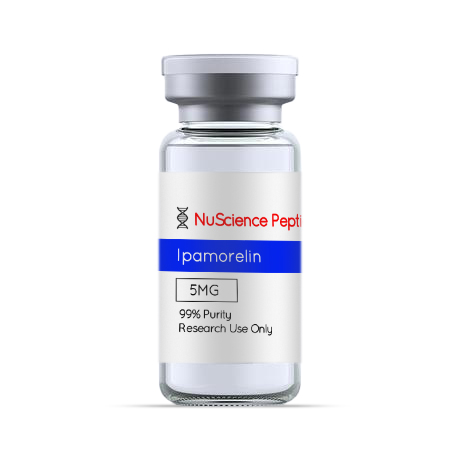

Ipamorelin Peptide: Enhance Your Research on Energy and Well-Being
This product is not intended for weight loss, human consumption, or veterinary use. It is sold for research purposes only. Please handle with care and follow all safety guidelines for the specific chemicals involved.
Ipamorelin, a synthetic pentapeptide, has garnered attention in rat research due to its potent and selective growth hormone (GH)-releasing properties. Studies have demonstrated its efficacy in promoting longitudinal bone growth, increasing bone mineral content, and enhancing body weight gain in rodent models.
In a study by Johansen et al., adult female rats administered ipamorelin subcutaneously three times daily for 15 days exhibited significant increases in longitudinal bone growth rates. This effect was attributed to the peptide’s ability to stimulate GH release without significantly affecting other hormones such as cortisol or prolactin.
Further research by Raun et al. confirmed ipamorelin’s selectivity as a GH secretagogue. In vitro experiments demonstrated that ipamorelin effectively stimulated GH release from primary rat pituitary cells with potency comparable to GHRP-6. Importantly, in vivo studies in anesthetized rats showed that ipamorelin induced GH release without elevating plasma levels of cortisol, indicating a targeted action on GH secretion pathways.
Additionally, Malmlöf et al. investigated the long-term effects of ipamorelin on bone mass in young adult female rats. Over a 12-week treatment period, daily subcutaneous injections of ipamorelin resulted in a significant increase in bone mineral content. This finding suggests potential applications of ipamorelin in conditions characterized by reduced bone density or impaired growth.
Collectively, these studies underscore ipamorelin’s potential as a therapeutic agent in promoting growth and bone health. Its selective mechanism of action, primarily influencing GH release without perturbing other hormonal axes, makes it a promising candidate for further research in growth-related disorders and osteoporosis.
References:
Johansen, P. B., Nowak, J., Skjaerbaek, C., Flyvbjerg, A., Andreassen, T. T., Wilken, M., & Orskov, H. (1999). Ipamorelin, a new growth-hormone-releasing peptide, induces longitudinal bone growth in rats. Growth Hormone & IGF Research, 9(2), 106–113. https://pubmed.ncbi.nlm.nih.gov/10373343/
Raun, K., Hansen, B. S., Johansen, N. L., Thøgersen, H., Madsen, K., Ankersen, M., & Andersen, P. H. (1998). Ipamorelin, the first selective growth hormone secretagogue. European Journal of Endocrinology, 139(5), 552–561. https://pubmed.ncbi.nlm.nih.gov/9849822/
Malmlöf, K., Johansen, P. B., Haahr, P. M., Wilken, M., & Oxlund, H. (1999). The GH secretagogues ipamorelin and GH-releasing peptide-6 increase bone mineral content in adult female rats. Journal of Endocrinology, 165(3), 569–577. https://joe.bioscientifica.com/view/journals/joe/165/3/569.xml
NuScience Peptides sells research products only, they are not for human consumption.
Synonyms:
Ipamorelin Acetate, IPAM, NNC-26-0161
ALL LITERATURE, INFORMATION, AND DATA, PROVIDED ON THIS WEBSITE ARE FOR INFORMATIONAL AND EDUCATIONAL PURPOSES ONLY.
Properties
| Molecular Formula |
C38H49N9O5 |
|---|---|
| Molecular Weight | 711.9 |
| Monoisotopic Mass | 711.38566570 |
| Polar Area | 240 |
| Complexity | 1200 |
| XLogP | 1.8 |
| Heavy Atom Count | 52 |
| Hydrogen Bond Donor Count | 8 |
| Hydrogen Bond Acceptor Count | 8 |
| Rotatable Bond Count | 19 |
| Physical Appearance | Fine White Lyophilized Powder |
| Stability | Lyophilized protein is to be stored at -20°C. It is recommended to aliquot the reconstituted (dissolved) protein into several discrete vials in order to avoid repeated freezing and thawing. Reconstituted protein can be stored at 4°C |
| PubChem LCSS |
Ipamorelin Laboratory Chemical Safety Summary |
Identifiers
| CID | 9831659 |
|---|---|
| CAS | 170851-70-4 |
| InChI | InChI=1S/C38H49N9O5/c1-38(2, 41)37(52)47-32(21-28-22-42-23-43-28)36(51)46-31(20-25-15-16-26-12-6-7-13-27(26)18-25)35(50)45-30(19-24-10-4-3-5-11-24)34(49)44-29(33(40)48)14-8-9-17-39/h3-7, 10-13, 15-16, 18, 22-23, 29-32H, 8-9, 14, 17, 19-21, 39, 41H2, 1-2H3, (H2, 40, 48)(H, 42, 43)(H, 44, 49)(H, 45, 50)(H, 46, 51)(H, 47, 52)/t29-, 30+, 31+, 32-/m0/s1 |
| InChIKey | NEHWBYHLYZGBNO-BVEPWEIPSA-N |
| Isomeric SMILES | CC(C)(C(=O)N[C@@H](CC1=CN=CN1)C(=O)N[C@H](CC2=CC3=CC=CC=C3C=C2)C(=O)N[C@H](CC4=CC=CC=C4)C(=O)N[C@@H](CCCCN)C(=O)N)N |
| Canonical SMILES | CC(C)(C(=O)NC(CC1=CN=CN1)C(=O)NC(CC2=CC3=CC=CC=C3C=C2)C(=O)NC(CC4=CC=CC=C4)C(=O)NC(CCCCN)C(=O)N)N |
| IUPAC Name | (2S)-6-amino-2-[[(2R)-2-[[(2R)-2-[[(2S)-2-[(2-amino-2-methylpropanoyl)amino]-3-(1H-imidazol-5-yl)propanoyl]amino]-3-naphthalen-2-ylpropanoyl]amino]-3-phenylpropanoyl]amino]hexanamide |
Related products