LL-37 Cathelicidin: Research Background and Preclinical Findings
This product is not intended for weight loss, human consumption, or veterinary use. It is sold for research purposes only. Please handle with care and follow all safetyWhat is LL-37 cathelicidin used for in research?
guidelines for the specific chemicals involved.
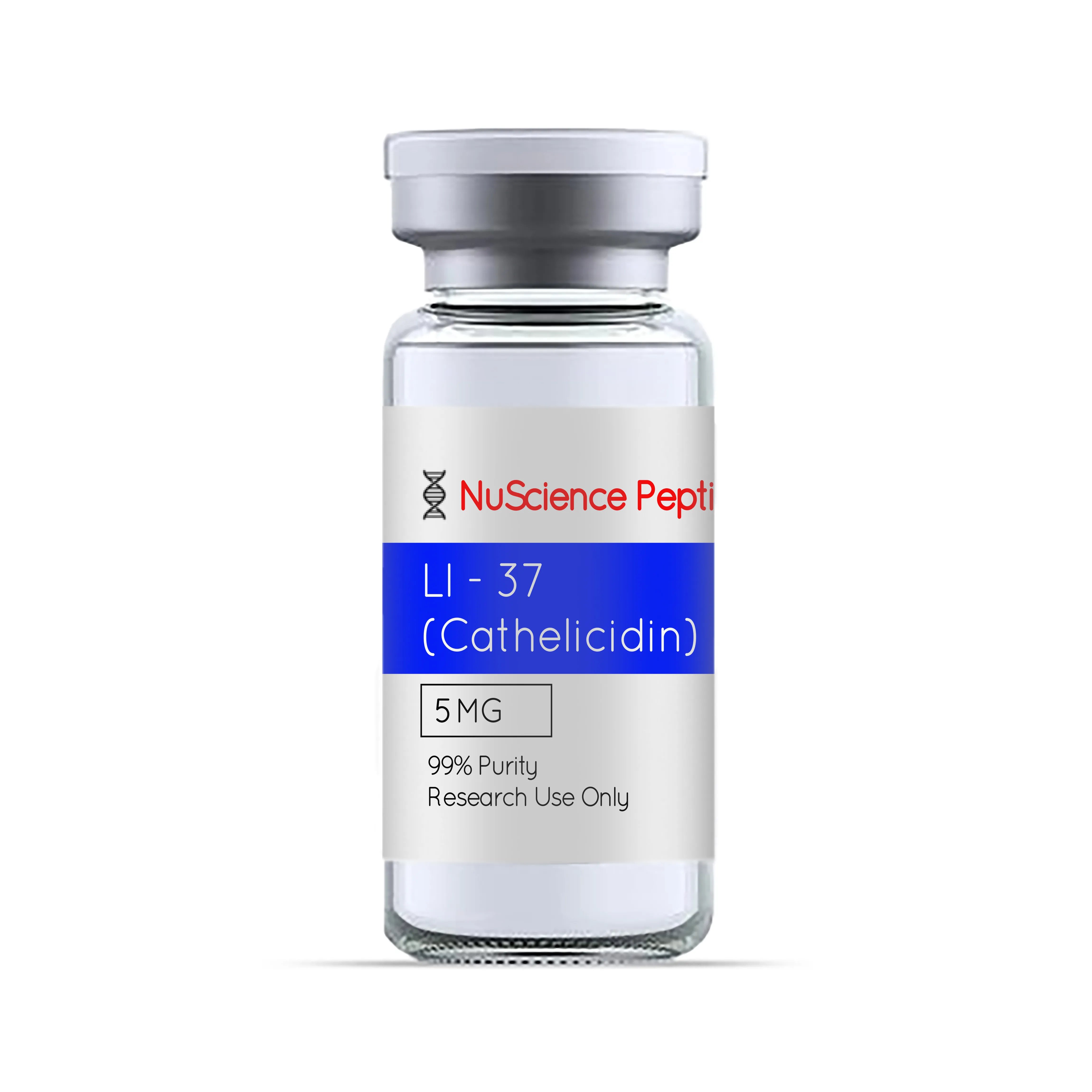
LL-37 is the only known human cathelicidin antimicrobial peptide, derived from the C-terminal domain of hCAP-18. It belongs to a family of host defense peptides studied for broad-spectrum antimicrobial properties, immunomodulatory activity, and wound-healing mechanisms. In preclinical studies using lab rats, LL-37 cathelicidin has been investigated as a research tool for examining infections and inflammatory conditions due to its ability to modulate immune responses and preserve tissue integrity in research models.
A study by Zhang et al. (2020) examined LL-37 in a rat model of methicillin-resistant Staphylococcus aureus (MRSA) skin infection. Results indicated reduced bacterial load and inflammation, with enhanced bacterial clearance and accelerated wound healing parameters compared to control groups in the research model. (PMID: 32019965).
Another study by Lyu et al. (2019) examined LL-37 cathelicidin in a lipopolysaccharide (LPS)-induced lung injury model. LL-37 administration was associated with attenuated inflammation and reduced oxidative stress markers in rat lung tissues. The findings indicated that LL-37 modulated the expression of cytokines such as TNF-a and IL-6 in the research model. (PMID: 31669328).
Lastly, research by Jiang et al. (2021) evaluated LI-37 in a chemically-induced colitis model. The peptide significantly improved colon morphology, reduced pro-inflammatory cytokines, and increased the expression of tight junction proteins, indicating enhanced barrier protection in the gastrointestinal tract (PMID: 34125549).
Conclusion
Preclinical findings across these rat models indicate that LL-37 cathelicidin exhibits antimicrobial, anti-inflammatory, and tissue-repair related activity in controlled research settings. These findings support its continued investigation as a research compound in immunology and antimicrobial peptide research. NuScience Peptides supplies LL-37 (CAP-18) in 5mg lyophilized vials at 99%+ purity, lab tested, for laboratory research use only. Certificates of Analysis are available on the NuScience Lab Test Results page.
Product Specifications Table
| Property | Value |
| Peptide Name | LL-37 (Human Cathelicidin Antimicrobial Peptide) |
| Alternate Name | CAP-18, hCAP-18 C-terminal fragment |
| Vial Size | 5mg |
| Amino Acids | 37 |
| Amino Acid Sequence | LLGDFFRKSKEKIGKEFKRIVQRIKDFLRNLVPRTES |
| Molecular Formula | C205H340N60O53 |
| Molecular Weight | 4493.3 g/mol |
| CAS Number | 154947-66-7 |
| Form | Lyophilized powder |
| Purity | 99%+ |
| Storage | Store lyophilized at 2–8°C. After reconstitution, freeze aliquots at -20°C. |
| Testing | Third-party lab tested – COAs available |
| Grade | Research use only. Not for human consumption. |
Handling, Reconstitution and Storage
- Store lyophilized LL-37 at 2-8C. For longer storage, freeze at -20C.
- Reconstitute with sterile water or bacteriostatic water under aseptic conditions
- After reconstitution, aliquot and freeze at -20C to avoid repeated freeze-thaw cycles
- Protect from light and moisture at all times
- For comprehensive storage protocols, refer to the NuScience Peptide Handling and Storage guide
- Third-party lab testing Certificates of Analysis are available on the NuScience Lab Test Results page
- This product is for laboratory research use only. Not for human consumption.
ALL LITERATURE, INFORMATION, AND DATA, PROVIDED ON THIS WEBSITE ARE FOR INFORMATIONAL AND EDUCATIONAL PURPOSES ONLY.
Properties
| Molecular Formula |
|---|
| Molecular Weight |
| Monoisotopic Mass |
| Polar Area |
| Complexity |
| XLogP |
| Heavy Atom Count |
| Hydrogen Bond Donor Count |
| Hydrogen Bond Acceptor Count |
| Rotatable Bond Count |
| Physical Appearance |
| Stability |
| PubChem LCSS |
Identifiers
| CID |
|---|
| CAS |
| InChI |
| InChIKey |
| Isomeric SMILES |
| Canonical SMILES |
| IUPAC Name |
Related products