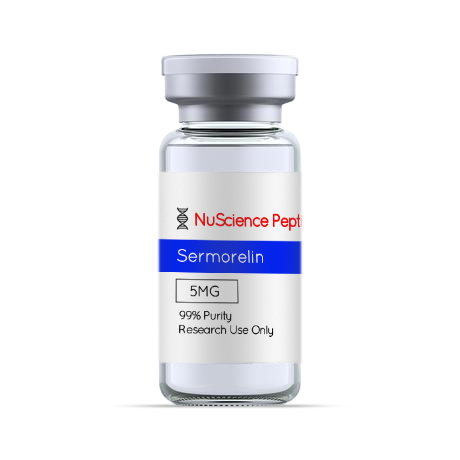


Sermorelin
This product is not intended for weight loss, human consumption, or veterinary use. It is sold for research purposes only. Please handle with care and follow all safety guidelines for the specific chemicals involved.
Sermorelin 5mg is a synthetic analog of growth hormone-releasing hormone (GHRH) that has been extensively studied in rat models to elucidate its physiological effects and mechanisms of action. This sermorelin peptide is widely referenced in peptide sciences research for its role in regulating growth hormone (GH) secretion and its downstream biological activities.
One pivotal study demonstrated that intravenous administration of human GHRH-(1-29)NH2 in anesthetized rats elicited a dose-dependent increase in plasma GH levels. The minimal effective dose was identified as 250 ng/kg, highlighting Sermorelin 5mg’s potency in stimulating GH release. These findings underscore the importance of this sermorelin peptide in controlled laboratory investigations and why researchers choose to buy sermorelin peptide for preclinical studies.
Further research explored the synergistic effects of sermorelin with other GH secretagogues. In primary pituitary cell cultures, the combination of GHRH and growth hormone-releasing peptide-6 (GHRP-6) produced a more pronounced GH release than either agent alone. This synergy highlights the potential applications of sermorelin peptides for sale in research protocols aimed at studying GH regulatory mechanisms.
The metabolic stability of Sermorelin 5mg has also been characterized. Studies indicate that rat GHRH-(1-29)NH2 undergoes rapid degradation in serum and liver homogenates, with half-lives of approximately 18 and 13 minutes, respectively. This rapid catabolism explains why molecular modifications are often explored in sermorelin peptide sciences to improve experimental consistency in research settings.
In addition to endocrine effects, Sermorelin has been studied for its impact on inflammatory pathways. Research indicates that the GHRH receptor (GHRH-R) interacts with the JAK2/STAT3 signaling pathway, influencing inflammatory responses. Inhibition of this pathway in rat models led to reduced ocular inflammation, demonstrating the broad potential applications of Sermorelin 5mg in controlled laboratory research.
Moreover, pharmacokinetic studies of sermorelin analogs, such as CJC-1295 (a tetrasubstituted hGRF(1-29)), show prolonged plasma presence beyond 72 hours post-injection in rats. These findings inform ongoing investigations in sermorelin peptide sciences to optimize stability and GH regulatory effects.
Collectively, these studies emphasize the significance of sermorelin peptides for sale in research settings, providing valuable insights into GH regulation, receptor signaling, and metabolic pathways. Sermorelin 5mg remains a staple in peptide research for laboratories exploring endocrine and inflammatory mechanisms.
References:
- Boulanger, L., Lazure, C., Lefrançois, L., & Gaudreau, P. (1992). Catabolism of rat growth hormone-releasing factor(1-29) amide in serum and liver homogenate. Peptides, 13(4), 755-761. https://pubmed.ncbi.nlm.nih.gov/1437711/
- Cheng, K., Chan, W. W., Butler, B., Barreto, A., & Smith, R. G. (1989). The synergistic effects of His-D-Trp-Ala-Trp-D-Phe-Lys-NH2 on growth hormone (GH)-releasing factor-stimulated GH release and intracellular adenosine 3′,5′-monophosphate accumulation in rat primary pituitary cell culture. Endocrinology, 124(6), 2791-2798. https://pubmed.ncbi.nlm.nih.gov/2541999/
- Horváth, J. E., Groot, K., & Schally, A. V. (1995). Growth hormone-releasing hormone stimulates cAMP release in superfused rat pituitary cells. Proceedings of the National Academy of Sciences, 92(6), 1856-1860. https://pubmed.ncbi.nlm.nih.gov/7892191/
- Liu, Y., Wang, Y., Zhang, Y., et al. (2020). Signaling mechanisms of growth hormone-releasing hormone receptor in inflammation. Proceedings of the National Academy of Sciences, 117(10), 5978-5987. https://pubmed.ncbi.nlm.nih.gov/32123064/
- Lapierre, H., et al. (2005). Human growth hormone-releasing factor (hGRF)1-29-albumin conjugate: pharmacokinetics and pharmacodynamics in rats. Endocrinology, 146(2), 703-708. https://pubmed.ncbi.nlm.nih.gov/15817669/
ALL LITERATURE, INFORMATION, AND DATA, PROVIDED ON THIS WEBSITE ARE FOR INFORMATIONAL AND EDUCATIONAL PURPOSES ONLY.
Properties
| Molecular Formula |
C149H246N44O42S |
|---|---|
| Molecular Weight | 3357.9 |
| Monoisotopic Mass | 3355.8186992 |
| Polar Area | 1470 |
| Complexity | 7640 |
| XLogP | -12.1 |
| Heavy Atom Count | 236 |
| Hydrogen Bond Donor Count | 52 |
| Hydrogen Bond Acceptor Count | 49 |
| Rotatable Bond Count | 118 |
| Physical Appearance | Fine White Lyophilized Powder |
| Stability | Lyophilized protein is to be stored at -20°C. It is recommended to aliquot the reconstituted (dissolved) protein into several discrete vials in order to avoid repeated freezing and thawing. Reconstituted protein can be stored at 4°C |
| PubChem LCSS |
Sermorelin Laboratory Chemical Safety Summary |
Identifiers
| CID | 16129620 |
|---|---|
| CAS | 86168-78-7 |
| InChI | InChI=1S/C149H246N44O42S/c1-20-77(13)116(191-122(211)81(17)168-132(221)104(66-113(204)205)178-121(210)79(15)167-123(212)88(152)62-84-39-43-86(198)44-40-84)145(234)185-102(63-83-32-23-22-24-33-83)138(227)193-118(82(18)197)146(235)186-103(65-111(155)202)137(226)189-108(71-196)142(231)182-101(64-85-41-45-87(199)46-42-85)136(225)175-93(38-31-56-165-149(161)162)126(215)174-91(35-26-28-53-151)131(220)190-115(76(11)12)143(232)184-97(58-72(3)4)124(213)166-68-112(203)170-94(47-49-109(153)200)128(217)180-100(61-75(9)10)135(224)188-106(69-194)140(229)169-80(16)120(209)172-92(37-30-55-164-148(159)160)125(214)173-90(34-25-27-52-150)127(216)179-99(60-74(7)8)134(223)181-98(59-73(5)6)133(222)176-95(48-50-110(154)201)129(218)183-105(67-114(206)207)139(228)192-117(78(14)21-2)144(233)177-96(51-57-236-19)130(219)187-107(70-195)141(230)171-89(119(156)208)36-29-54-163-147(157)158/h22-24, 32-33, 39-46, 72-82, 88-108, 115-118, 194-199H, 20-21, 25-31, 34-38, 47-71, 150-152H2, 1-19H3, (H2, 153, 200)(H2, 154, 201)(H2, 155, 202)(H2, 156, 208)(H, 166, 213)(H, 167, 212)(H, 168, 221)(H, 169, 229)(H, 170, 203)(H, 171, 230)(H, 172, 209)(H, 173, 214)(H, 174, 215)(H, 175, 225)(H, 176, 222)(H, 177, 233)(H, 178, 210)(H, 179, 216)(H, 180, 217)(H, 181, 223)(H, 182, 231)(H, 183, 218)(H, 184, 232)(H, 185, 234)(H, 186, 235)(H, 187, 219)(H, 188, 224)(H, 189, 226)(H, 190, 220)(H, 191, 211)(H, 192, 228)(H, 193, 227)(H, 204, 205)(H, 206, 207)(H4, 157, 158, 163)(H4, 159, 160, 164)(H4, 161, 162, 165) |
| InChIKey | WGWPRVFKDLAUQJ-UHFFFAOYSA-N |
| Isomeric SMILES | CC[C@H](C)[C@@H](C(=O)N[C@@H](CC1=CC=CC=C1)C(=O)N[C@@H]([C@@H](C)O)C(=O)N[C@@H](CC(=O)N)C(=O)N[C@@H](CO)C(=O)N[C@@H](CC2=CC=C(C=C2)O)C(=O)N[C@@H](CCCNC(=N)N)C(=O)N[C@@H](CCCCN)C(=O)N[C@@H](C(C)C)C(=O)N[C@@H](CC(C)C)C(=O)NCC(=O)N[C@@H](CCC(=O)N)C(=O)N[C@@H](CC(C)C)C(=O)N[C@@H](CO)C(=O)N[C@@H](C)C(=O)N[C@@H](CCCNC(=N)N)C(=O)N[C@@H](CCCCN)C(=O)N[C@@H](CC(C)C)C(=O)N[C@@H](CC(C)C)C(=O)N[C@@H](CCC(=O)N)C(=O)N[C@@H](CC(=O)O)C(=O)N[C@@H]([C@@H](C)CC)C(=O)N[C@@H](CCSC)C(=O)N[C@@H](CO)C(=O)N[C@@H](CCCNC(=N)N)C(=O)N)NC(=O)[C@H](C)NC(=O)[C@H](CC(=O)O)NC(=O)[C@H](C)NC(=O)[C@H](CC3=CC=C(C=C3)O)N |
| Canonical SMILES | CCC(C)C(C(=O)NC(CC1=CC=CC=C1)C(=O)NC(C(C)O)C(=O)NC(CC(=O)N)C(=O)NC(CO)C(=O)NC(CC2=CC=C(C=C2)O)C(=O)NC(CCCNC(=N)N)C(=O)NC(CCCCN)C(=O)NC(C(C)C)C(=O)NC(CC(C)C)C(=O)NCC(=O)NC(CCC(=O)N)C(=O)NC(CC(C)C)C(=O)NC(CO)C(=O)NC(C)C(=O)NC(CCCNC(=N)N)C(=O)NC(CCCCN)C(=O)NC(CC(C)C)C(=O)NC(CC(C)C)C(=O)NC(CCC(=O)N)C(=O)NC(CC(=O)O)C(=O)NC(C(C)CC)C(=O)NC(CCSC)C(=O)NC(CO)C(=O)NC(CCCNC(=N)N)C(=O)N)NC(=O)C(C)NC(=O)C(CC(=O)O)NC(=O)C(C)NC(=O)C(CC3=CC=C(C=C3)O)N |
| IUPAC Name | 4-[[1-[[1-[[1-[[1-[[4-amino-1-[[1-[[1-[[1-[[6-amino-1-[[1-[[1-[[2-[[5-amino-1-[[1-[[1-[[1-[[1-[[6-amino-1-[[1-[[1-[[5-amino-1-[[1-[[1-[[1-[[1-[(1-amino-5-carbamimidamido-1-oxopentan-2-yl)amino]-3-hydroxy-1-oxopropan-2-yl]amino]-4-methylsulfanyl-1-oxobutan-2-yl]amino]-3-methyl-1-oxopentan-2-yl]amino]-3-carboxy-1-oxopropan-2-yl]amino]-1, 5-dioxopentan-2-yl]amino]-4-methyl-1-oxopentan-2-yl]amino]-4-methyl-1-oxopentan-2-yl]amino]-1-oxohexan-2-yl]amino]-5-carbamimidamido-1-oxopentan-2-yl]amino]-1-oxopropan-2-yl]amino]-3-hydroxy-1-oxopropan-2-yl]amino]-4-methyl-1-oxopentan-2-yl]amino]-1, 5-dioxopentan-2-yl]amino]-2-oxoethyl]amino]-4-methyl-1-oxopentan-2-yl]amino]-3-methyl-1-oxobutan-2-yl]amino]-1-oxohexan-2-yl]amino]-5-carbamimidamido-1-oxopentan-2-yl]amino]-3-(4-hydroxyphenyl)-1-oxopropan-2-yl]amino]-3-hydroxy-1-oxopropan-2-yl]amino]-1, 4-dioxobutan-2-yl]amino]-3-hydroxy-1-oxobutan-2-yl]amino]-1-oxo-3-phenylpropan-2-yl]amino]-3-methyl-1-oxopentan-2-yl]amino]-1-oxopropan-2-yl]amino]-3-[2-[[2-amino-3-(4-hydroxyphenyl)propanoyl]amino]propanoylamino]-4-oxobutanoic acid |
Related products

Peptides