
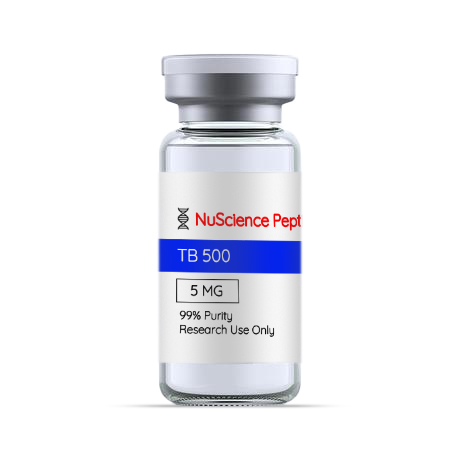
TB-500 Fragment 17-23: Thymosin Beta-4 Active Domain Research
This product is not intended for weight loss, human consumption, or veterinary use. It is sold for research purposes only. Please handle with care and follow all safety guidelines for the specific chemicals involved.
TB-500 Fragment 17-23 is a synthetic heptapeptide derived from the active region of thymosin beta-4 (Tβ4), consisting of amino acids 17-23 (sequence Ac-LKKTETQ) with an approximate molecular weight of approximately 889 Da. This short fragment represents the biologically active domain studied for many of the parent peptide’s regenerative and cytoprotective properties in preclinical models. Analytical studies have confirmed the structure of this TB-500 fragment in formulations using high-resolution mass spectrometry, supporting its identity as the core actin-binding component. (PubMed).
In experimental research, particularly in rodent (rat) models, Tβ4 and its active regions have been associated with enhanced tissue repair, angiogenesis, and modulation of inflammation. The 17–23 fragment is believed to contribute significantly to these effects by influencing actin dynamics and cellular migration, which are essential for wound healing and regeneration. Studies indicate that this region can promote endothelial cell activity and blood vessel formation, key mechanisms underlying improved tissue recovery (PMC).
Rat studies using full-length Tb4 provide insight into the biological relevance of the TB-500 fragment 17-23 region. In a rat model of severe acute pancreatitis, administration of Tb4 significantly reduced inflammatory cytokines (TNF-a, IL-1b, IL-6), decreased neutrophil infiltration, and improved histological outcomes. These findings point to anti-inflammatory and tissue-protective properties mediated through pathways such as NF-kB inhibition in preclinical models. (PMC).
Additionally, earlier wound-healing studies in rats demonstrated accelerated re-epithelialization, increased collagen deposition, and enhanced angiogenesis following Tβ4 exposure, supporting its regenerative potential (PubMed).
Overall, while direct studies on the isolated TB-500 fragment 17-23 in rats remain limited, existing evidence supports its characterization as the key actin-binding motif of Tb4. Experimental data from rat models suggest that peptides containing this region may influence inflammation, angiogenesis, and tissue repair processes under controlled laboratory conditions. NuScience Peptides supplies TB-500 Fragment 17-23 in 10mg lyophilized vials at 99%+ purity, lab tested, for laboratory research use only. Certificates of Analysis are available on the NuScience Lab Test Results page.
Product Specifications Table
| Property | Value |
| Peptide Name | TB-500 Fragment 17-23 |
| Amino Acid Sequence | Ac-LKKTETQ (Acetyl-Leu-Lys-Lys-Thr-Glu-Thr-Gln) |
| Amino Acids | 7 (heptapeptide) |
| Molecular Weight | ~889 Da |
| Parent Peptide | Thymosin Beta-4 (Tb4), residues 17-23 |
| Vial Size | 10mg |
| Form | Lyophilized powder |
| Purity | 99%+ |
| Key Domain | Actin-binding domain of thymosin beta-4 |
| Storage | Store lyophilized at -20°C. Reconstituted solution store at 4°C. |
| Testing | Third-party lab tested – COAs available |
| Grade | Research use only. Not for human consumption. |
TB-500 Fragment 17-23 vs Full TB-500 Comparison
| Feature | TB-500 Fragment 17-23 (This Product) | Full TB-500 (Thymosin Beta-4) |
| Amino acids | 7 (heptapeptide) | 43 |
| Molecular weight | ~889 Da | ~4963 Da |
| Sequence | Ac-LKKTETQ (residues 17-23) | Full 43 amino acid TB-500 sequence |
| Primary research application | Actin-binding domain specificity studies | Broader tissue repair, angiogenesis, anti-inflammatory research |
| Available at NuScience | Yes – 10mg | Yes |
Handling, Reconstitution and Storage
- Store lyophilized TB-500 Fragment 17-23 vials at -20C until use
- Reconstitute with bacteriostatic water under aseptic conditions
- Use the NuScience Peptide Calculator to determine the correct BAC water volume for your target research concentration
- Once reconstituted, store at 4C and use within the research protocol window
- For comprehensive storage protocols, refer to the NuScience Peptide Handling and Storage guide
- This product is for laboratory research use only. Not for human consumption.
References (APA)
Esposito, S., Deventer, K., Goeman, J., Van der Eycken, J., & Van Eenoo, P. (2012). Synthesis and characterization of the N-terminal acetylated 17–23 fragment of thymosin beta-4 identified in TB-500. Drug Testing and Analysis, 4(9), 733–738. https://doi.org/10.1002/dta.1402
He, X., Yu, J., & Wang, W. (2015). Effects of thymosin β4 on a rat model of severe acute pancreatitis. Molecular Medicine Reports, 12(6), 8077–8084. https://pubmed.ncbi.nlm.nih.gov/26668646/
Malinda, K. M., Goldstein, A. L., & Kleinman, H. K. (1999). Thymosin β4 accelerates wound healing. Journal of Investigative Dermatology, 113(3), 364–368. https://pubmed.ncbi.nlm.nih.gov/10469335/
ALL LITERATURE, INFORMATION, AND DATA, PROVIDED ON THIS WEBSITE ARE FOR INFORMATIONAL AND EDUCATIONAL PURPOSES ONLY.
Properties
| Molecular Formula |
|---|
| Molecular Weight |
| Monoisotopic Mass |
| Polar Area |
| Complexity |
| XLogP |
| Heavy Atom Count |
| Hydrogen Bond Donor Count |
| Hydrogen Bond Acceptor Count |
| Rotatable Bond Count |
| Physical Appearance |
| Stability |
| PubChem LCSS |
Identifiers
| CID |
|---|
| CAS |
| InChI |
| InChIKey |
| Isomeric SMILES |
| Canonical SMILES |
| IUPAC Name |
Related products