

Cagrilintide
This product is not intended for weight loss, human consumption, or veterinary use. It is sold for research purposes only. Please handle with care and follow all safety guidelines for the specific chemicals involved.
Cagrilintide is a long-acting amylin analog featuring N-terminal lipidation that extends its half-life through albumin binding. It has been investigated in preclinical and clinical research models for its effects on metabolic regulation and energy homeostasis. In rodent models, particularly rats, cagrilintide 5mg research has demonstrated significant effects on weight management and appetite pathway modulation.
A study by Larsen et al. (2022) compared cagrilintide to the dual amylin and calcitonin receptor agonist KBP-336 in obese and diabetic rat models. The research found that while both agents reduced body weight and improved glycemic control in the study models, KBP-336 exhibited superior efficacy, suggesting the importance of receptor activation balance in preclinical metabolic research outcomes.
Further exploration into the neural mechanisms of cagrilintide was conducted by a team at the University of Copenhagen (2025). Their cross-species analysis revealed that cagrilintide acts on neurons in the brainstem’s dorsal vagal complex, particularly those expressing calcitonin receptors. In rats, cagrilintide promoted long-term transcriptional changes in these neurons, indicating a sustained impact on appetite regulation and energy balance.
In a clinical research context, a phase 2 trial assessed the co-administration of cagrilintide and semaglutide (CagriSema) in individuals with type 2 diabetes. The study reported greater weight reduction and improved glycemic control compared to either agent alone, highlighting this combination as an active area of metabolic research (Frias et al., 2023). NuScience Peptides also supplies a cagrilintide semaglutide combination for laboratory research purposes.
Additionally, research by Sun et al. (2024) investigated the combination of cagrilintide with a novel GLP-1 analogue derived from bullfrog. In diet-induced obese mice, this combination led to significant weight reduction and enhanced glucose regulation, surpassing the effects of semaglutide alone.
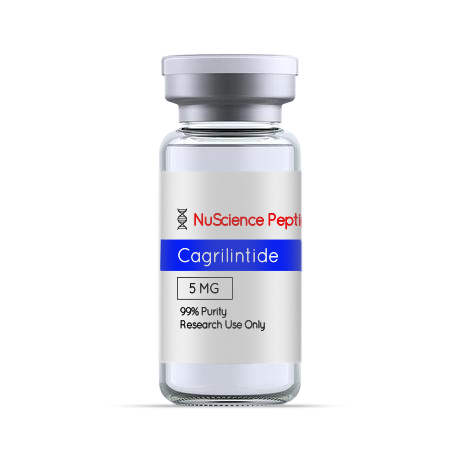
These findings position cagrilintide as an active subject of research in metabolic and appetite regulation studies, both as a standalone compound and in combination with agents such as semaglutide. NuScience Peptides supplies cagrilintide for sale in 5mg lyophilized vials at 99%+ purity, lab tested, for laboratory research use only. Third-party Certificates of Analysis are available on the NuScience Lab Test Results page.
Product Specifications Table
| Feature | Value |
| Active Compound | Cagrilintide |
| Vial Size | 5mg per vial |
| Form | Lyophilized powder |
| Purity | 99%+ |
| Molecular Formula | C194H312N54O59S2 |
| Molecular Weight | 4409.01 g/mol |
| CAS Number | 1415456-99-3 |
| Peptide Class | Long-acting amylin analog |
| Key Structural Feature | N-terminal lipidation for extended half-life via albumin binding |
| Storage | Store at or below 25°C, sealed, away from heat, light, and moisture |
| Testing | Third-party lab tested – COAs available |
| Grade | Research use only. Not for human consumption. |
Handling, Reconstitution and Storage
- Store the lyophilized cagrilintide vial at or below 25C, sealed and away from direct light and moisture
- Reconstitute with bacteriostatic water under aseptic conditions
- Use the NuScience Peptide Calculator to determine the correct BAC water volume for your target research concentration
to determine the correct BAC water volume for your target research concentration. - Once reconstituted, store at 4C and use within the research protocol window
- For comprehensive storage protocols, see the NuScience Peptide Handling and Storage guide
- This product is for laboratory research use only. Not for human consumption.
References:
- Larsen, A. T., Mohamed, K. E., Sonne, N., Bredtoft, E.-M., & Andersen, F. (2022). Comparing the efficacies of the dual amylin and calcitonin receptor agonists cagrilintide and KBP-336 on metabolic parameters in preclinical models. Biomedicine & Pharmacotherapy, 156, 113969. https://pubmed.ncbi.nlm.nih.gov/36242844/
- University of Copenhagen. (2025). A Cross-Species Atlas of the Dorsal Vagal Complex Reveals Neural Mechanisms of Cagrilintide Action. bioRxiv. https://pubmed.ncbi.nlm.nih.gov/39868309/
- Frias, J. P., Deenadayalan, S., Erichsen, L., Knop, F. K., & Lingvay, I. (2023). Efficacy and safety of co-administered once-weekly cagrilintide with once-weekly semaglutide in type 2 diabetes: a multicentre, randomised, double-blind, active-controlled, phase 2 trial. The Lancet, 402(10397), 123–134. https://pubmed.ncbi.nlm.nih.gov/37364590/
- Sun, X., Yang, D., Li, Y., Shi, J., & Zhang, X. (2024). Identification and utility exploration of a highly potent and long-acting bullfrog GLP-1 analogue in GLP-1 and amylin combination therapy. Peptides, 177, 171203. https://pubmed.ncbi.nlm.nih.gov/38582303/
- D’Ascanio, A. M., Mullally, J. A., & Frishman, W. H. (2023). Cagrilintide: A Long-Acting Amylin Analog for the Treatment of Obesity. Cardiology in Review, 31(1), 45–50. https://pubmed.ncbi.nlm.nih.gov/36883831/
ALL LITERATURE, INFORMATION, AND DATA, PROVIDED ON THIS WEBSITE ARE FOR INFORMATIONAL AND EDUCATIONAL PURPOSES ONLY.
Properties
| Molecular Formula |
|---|
| Molecular Weight |
| Monoisotopic Mass |
| Polar Area |
| Complexity |
| XLogP |
| Heavy Atom Count |
| Hydrogen Bond Donor Count |
| Hydrogen Bond Acceptor Count |
| Rotatable Bond Count |
| Physical Appearance |
| Stability |
| PubChem LCSS |
Identifiers
| CID |
|---|
| CAS |
| InChI |
| InChIKey |
| Isomeric SMILES |
| Canonical SMILES |
| IUPAC Name |
Related products