
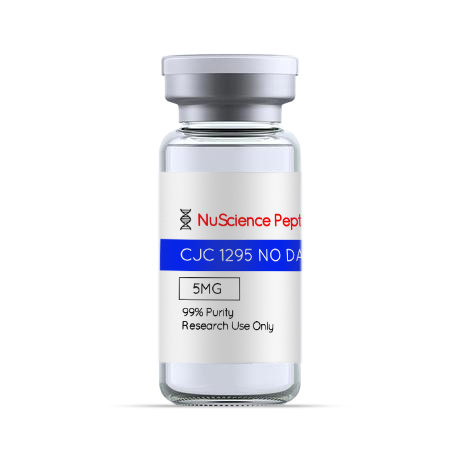
CJC-1295 W/DAC
This product is not intended for weight loss, human consumption, or veterinary use. It is sold for research purposes only. Please handle with care and follow all safety guidelines for the specific chemicals involved.
CJC-1295 W/DAC (Drug Affinity Complex) is a long-acting analog of growth hormone-releasing hormone (GHRH) that has garnered attention in preclinical research settings for its ability to support sustained stimulation of growth hormone (GH) secretion and insulin-like growth factor-I (IGF-I) production. This CJC-1295 DAC peptide is commonly utilized as a research peptide in experimental models focused on growth-related and metabolic pathways.
In rat studies, CJC-1295 W/DAC 5mg demonstrated the capacity to elevate circulating GH levels and promote anabolic signaling, making it a valuable compound for investigating GH axis modulation. Pharmacokinetic evaluations revealed that CJC-1295 W/DAC remains detectable in circulation beyond 24 hours, a property attributed to the Drug Affinity Complex, which facilitates reversible binding to serum albumin and extends peptide half-life.
Additional research using GHRH knockout mouse models showed that repeated exposure to CJC-1295 W/DAC helped maintain normal growth patterns and body composition. Observed increases in total pituitary RNA and GH mRNA expression suggested stimulation and proliferation of somatotroph cells responsible for endogenous GH synthesis.
Human investigative studies further demonstrated that a single administration of CJC-1295 DAC resulted in elevated trough and mean GH secretion while preserving natural pulsatility. Corresponding increases in IGF-I levels highlighted the peptide’s relevance for studying sustained GH/IGF-I axis activation.
Collectively, these findings position CJC-1295 W/DAC as a well-characterized research peptide with prolonged biological presence, offering a robust platform for experimental exploration of growth hormone regulation, anabolic signaling, and metabolic research applications.
References
- Teichman, S. L., Neale, A., Lawrence, B., Gagnon, C., Castaigne, J. P., & Frohman, L. A. (2006). Pulsatile secretion of growth hormone (GH) persists during continuous stimulation by CJC-1295, a long-acting GH-releasing hormone analog. The Journal of Clinical Endocrinology & Metabolism, 91(3), 799–805. https://pubmed.ncbi.nlm.nih.gov/17018654/
- Lapierre, H., & Dufresne, Y. (2005). Human growth hormone-releasing factor (hGRF)1-29-albumin bioconjugates activate the GRF receptor on the anterior pituitary in rats: identification of CJC-1295 as a long-lasting GRF analog. Endocrinology, 146(7), 3052–3058. https://pubmed.ncbi.nlm.nih.gov/15817669/
- Ionescu, M., Frohman, L. A., & Castaigne, J. P. (2006). Once-daily administration of CJC-1295, a long-acting growth hormone-releasing hormone analog, maintains normal growth in GHRH knockout mice. Endocrinology, 147(11), 5319–5326. https://pubmed.ncbi.nlm.nih.gov/16822960/
- Smith, R. G., & van der Lely, A. J. (2005). Novel peptides for the treatment of growth hormone deficiency. Trends in Endocrinology & Metabolism, 16(5), 259–263. https://pubmed.ncbi.nlm.nih.gov/15871611/
- Ghigo, E., Arvat, E., & Camanni, F. (2001). Growth hormone-releasing peptides. European Journal of Endocrinology, 145(1), 1–9. https://pubmed.ncbi.nlm.nih.gov/11454508/
ALL LITERATURE, INFORMATION, AND DATA, PROVIDED ON THIS WEBSITE ARE FOR INFORMATIONAL AND EDUCATIONAL PURPOSES ONLY.
Properties
| Molecular Formula |
C167H272N48047 |
|---|---|
| Molecular Weight | 3647.2 |
| Monoisotopic Mass | 3645.0154843 |
| Polar Area | 1540 |
| Complexity | 8580 |
| XLogP | -11.7 |
| Heavy Atom Count | 258 |
| Hydrogen Bond Donor Count | 54 |
| Hydrogen Bond Acceptor Count | 52 |
| Rotatable Bond Count | 128 |
| Physical Appearance | Fine White Lyophilized Powder |
| Stability | Lyophilized protein is to be stored at -20°C. It is recommended to aliquot the reconstituted (dissolved) protein into several discrete vials in order to avoid repeated freezing and thawing. Reconstituted protein can be stored at 4°C |
| PubChem LCSS |
CJC-1295 WITH DAC Laboratory Chemical Safety Summary |
Identifiers
| CID | 91971820 |
|---|---|
| CAS | 446036-97-1 |
| InChI | InChI=1S/C165H269N47O46/c1-22-87(15)130(209-137(233)92(20)185-148(244)116(76-127(225)226)196-136(232)89(17)183-138(234)99(168)73-95-44-48-97(217)49-45-95)160(256)204-115(74-94-36-25-24-26-37-94)154(250)211-132(93(21)216)162(258)195-108(54-57-123(171)221)145(241)205-120(80-215)158(254)200-114(75-96-46-50-98(218)51-47-96)153(249)192-105(43-35-66-182-165(177)178)141(237)191-102(40-28-31-62-167)146(242)208-129(86(13)14)159(255)202-109(68-81(3)4)147(243)184-90(18)135(231)189-106(52-55-121(169)219)143(239)198-112(71-84(9)10)151(247)206-118(78-213)156(252)186-91(19)134(230)188-103(41-33-64-180-163(173)174)140(236)190-101(39-27-30-61-166)142(238)197-111(70-83(7)8)150(246)199-110(69-82(5)6)149(245)194-107(53-56-122(170)220)144(240)201-117(77-128(227)228)155(251)210-131(88(16)23-2)161(257)203-113(72-85(11)12)152(248)207-119(79-214)157(253)193-104(42-34-65-181-164(175)176)139(235)187-100(133(172)229)38-29-32-63-179-124(222)60-67-212-125(223)58-59-126(212)224/h24-26, 36-37, 44-51, 58-59, 81-93, 99-120, 129-132, 213-218H, 22-23, 27-35, 38-43, 52-57, 60-80, 166-168H2, 1-21H3, (H2, 169, 219)(H2, 170, 220)(H2, 171, 221)(H2, 172, 229)(H, 179, 222)(H, 183, 234)(H, 184, 243)(H, 185, 244)(H, 186, 252)(H, 187, 235)(H, 188, 230)(H, 189, 231)(H, 190, 236)(H, 191, 237)(H, 192, 249)(H, 193, 253)(H, 194, 245)(H, 195, 258)(H, 196, 232)(H, 197, 238)(H, 198, 239)(H, 199, 246)(H, 200, 254)(H, 201, 240)(H, 202, 255)(H, 203, 257)(H, 204, 256)(H, 205, 241)(H, 206, 247)(H, 207, 248)(H, 208, 242)(H, 209, 233)(H, 210, 251)(H, 211, 250)(H, 225, 226)(H, 227, 228)(H4, 173, 174, 180)(H4, 175, 176, 181)(H4, 177, 178, 182)/t87-, 88-, 89+, 90-, 91-, 92-, 93+, 99-, 100-, 101-, 102-, 103-, 104-, 105-, 106-, 107-, 108-, 109-, 110-, 111-, 112-, 113-, 114-, 115-, 116-, 117-, 118-, 119-, 120-, 129-, 130-, 131-, 132-/m0/s1 |
| InChIKey | ZUQGTWKGESAQCD-ZGFIGYLBSA-N |
| Isomeric SMILES | CC[C@H](C)[C@@H](C(=O)N[C@@H](CC1=CC=CC=C1)C(=O)N[C@@H]([C@@H](C)O)C(=O)N[C@@H](CCC(=O)N)C(=O)N[C@@H](CO)C(=O)N[C@@H](CC2=CC=C(C=C2)O)C(=O)N[C@@H](CCCNC(=N)N)C(=O)N[C@@H](CCCCN)C(=O)N[C@@H](C(C)C)C(=O)N[C@@H](CC(C)C)C(=O)N[C@@H](C)C(=O)N[C@@H](CCC(=O)N)C(=O)N[C@@H](CC(C)C)C(=O)N[C@@H](CO)C(=O)N[C@@H](C)C(=O)N[C@@H](CCCNC(=N)N)C(=O)N[C@@H](CCCCN)C(=O)N[C@@H](CC(C)C)C(=O)N[C@@H](CC(C)C)C(=O)N[C@@H](CCC(=O)N)C(=O)N[C@@H](CC(=O)O)C(=O)N[C@@H]([C@@H](C)CC)C(=O)N[C@@H](CC(C)C)C(=O)N[C@@H](CO)C(=O)N[C@@H](CCCNC(=N)N)C(=O)N[C@@H](CCCCNC(=O)CCN3C(=O)C=CC3=O)C(=O)N)NC(=O)[C@H](C)NC(=O)[C@H](CC(=O)O)NC(=O)[C@@H](C)NC(=O)[C@H](CC4=CC=C(C=C4)O)N |
| Canonical SMILES | CCC(C)C(C(=O)NC(CC1=CC=CC=C1)C(=O)NC(C(C)O)C(=O)NC(CCC(=O)N)C(=O)NC(CO)C(=O)NC(CC2=CC=C(C=C2)O)C(=O)NC(CCCNC(=N)N)C(=O)NC(CCCCN)C(=O)NC(C(C)C)C(=O)NC(CC(C)C)C(=O)NC(C)C(=O)NC(CCC(=O)N)C(=O)NC(CC(C)C)C(=O)NC(CO)C(=O)NC(C)C(=O)NC(CCCNC(=N)N)C(=O)NC(CCCCN)C(=O)NC(CC(C)C)C(=O)NC(CC(C)C)C(=O)NC(CCC(=O)N)C(=O)NC(CC(=O)O)C(=O)NC(C(C)CC)C(=O)NC(CC(C)C)C(=O)NC(CO)C(=O)NC(CCCNC(=N)N)C(=O)NC(CCCCNC(=O)CCN3C(=O)C=CC3=O)C(=O)N)NC(=O)C(C)NC(=O)C(CC(=O)O)NC(=O)C(C)NC(=O)C(CC4=CC=C(C=C4)O)N |
| IUPAC Name | (3S)-4-[[(2S)-1-[[(2S, 3S)-1-[[(2S)-1-[[(2S, 3R)-1-[[(2S)-5-amino-1-[[(2S)-1-[[(2S)-1-[[(2S)-1-[[(2S)-6-amino-1-[[(2S)-1-[[(2S)-1-[[(2S)-1-[[(2S)-5-amino-1-[[(2S)-1-[[(2S)-1-[[(2S)-1-[[(2S)-1-[[(2S)-6-amino-1-[[(2S)-1-[[(2S)-1-[[(2S)-5-amino-1-[[(2S)-1-[[(2S, 3S)-1-[[(2S)-1-[[(2S)-1-[[(2S)-1-[[(2S)-1-amino-6-[3-(2, 5-dioxopyrrol-1-yl)propanoylamino]-1-oxohexan-2-yl]amino]-5-carbamimidamido-1-oxopentan-2-yl]amino]-3-hydroxy-1-oxopropan-2-yl]amino]-4-methyl-1-oxopentan-2-yl]amino]-3-methyl-1-oxopentan-2-yl]amino]-3-carboxy-1-oxopropan-2-yl]amino]-1, 5-dioxopentan-2-yl]amino]-4-methyl-1-oxopentan-2-yl]amino]-4-methyl-1-oxopentan-2-yl]amino]-1-oxohexan-2-yl]amino]-5-carbamimidamido-1-oxopentan-2-yl]amino]-1-oxopropan-2-yl]amino]-3-hydroxy-1-oxopropan-2-yl]amino]-4-methyl-1-oxopentan-2-yl]amino]-1, 5-dioxopentan-2-yl]amino]-1-oxopropan-2-yl]amino]-4-methyl-1-oxopentan-2-yl]amino]-3-methyl-1-oxobutan-2-yl]amino]-1-oxohexan-2-yl]amino]-5-carbamimidamido-1-oxopentan-2-yl]amino]-3-(4-hydroxyphenyl)-1-oxopropan-2-yl]amino]-3-hydroxy-1-oxopropan-2-yl]amino]-1, 5-dioxopentan-2-yl]amino]-3-hydroxy-1-oxobutan-2-yl]amino]-1-oxo-3-phenylpropan-2-yl]amino]-3-methyl-1-oxopentan-2-yl]amino]-1-oxopropan-2-yl]amino]-3-[[(2R)-2-[[(2S)-2-amino-3-(4-hydroxyphenyl)propanoyl]amino]propanoyl]amino]-4-oxobutanoic acid |
Related products

Peptides