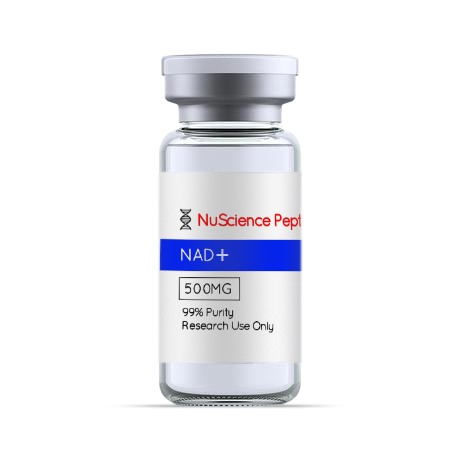
NAD+
This product is not intended for weight loss, human consumption, or veterinary use. It is sold for research purposes only. Please handle with care and follow all safety guidelines for the specific chemicals involved.
What is NAD+ Peptide?
NAD+ Research in Animal Models
NAD+ Neuroprotective Effects
NAD+ and Exercise Endurance Research
NAD+ Safety Research
References
- Pei, Zuowei, et al. “The Role of NAD⁺ in Myocardial Ischemia-induced Heart Failure in Sprague-Dawley Rats and Beagles.” Current Pharmaceutical Biotechnology, vol. 25, no. 17, 2024, pp. 2300–2311. PubMed
- Ferdaus, Sara Amelia, et al. “NAD⁺ Deficiency Plays Essential Roles in the Hyperuricemia of Stroke-Prone Spontaneously Hypertensive Rat via Xanthine Dehydrogenase to Xanthine Oxidase Conversion.” Biochemical and Biophysical Research Communications, vol. 744, 2025, p. 151136. PubMed
- Zhang, Ning, et al. “NAD⁺ Improves Cognitive Function and Reduces Neuroinflammation in Rats with Chronic Cerebral Hypoperfusion.” Neuroscience Letters, vol. 748, 2021, p. 135700. PubMed
- Conze, Douglas, et al. “Safety Assessment of High-Purity, Synthetic Nicotinamide Riboside (Nicotinamide Riboside Chloride) in Sprague-Dawley Rats.” Toxicology Reports, vol. 7, 2020, pp. 1–10. PubMed
- Gökce, E. C., et al. “Protective Effect of Nicotinamide Adenine Dinucleotide Against Spinal Cord Ischemia-Reperfusion Injury in Rats.” Journal of Neurosurgery: Spine, vol. 24, no. 6, 2016, pp. 949–959. PubMed
NuScience Peptides sells research products only, they are not for human consumption.
ALL LITERATURE, INFORMATION, AND DATA, PROVIDED ON THIS WEBSITE ARE FOR INFORMATIONAL AND EDUCATIONAL PURPOSES ONLY.
Properties
| Molecular Formula |
C21H27N7O14P2 |
|---|---|
| Molecular Weight | 663.4 |
| Monoisotopic Mass | 663.10912256 |
| Polar Area | 321 |
| Complexity | 1120 |
| XLogP | -6 |
| Heavy Atom Count | 44 |
| Hydrogen Bond Donor Count | 7 |
| Hydrogen Bond Acceptor Count | 18 |
| Rotatable Bond Count | 11 |
| Physical Appearance | Fine White Lyophilized Powder |
| Stability | Lyophilized protein is to be stored at -20°C. It is recommended to aliquot the reconstituted (dissolved) protein into several discrete vials in order to avoid repeated freezing and thawing. Reconstituted protein can be stored at 4°C |
| PubChem LCSS |
Laboratory Chemical Safety Summary (LCSS) Datasheet |
Identifiers
| CID | 5892 |
|---|---|
| CAS | 53-84-9 |
| InChI | InChI=1S/C21H27N7O14P2/c22-17-12-19(25-7-24-17)28(8-26-12)21-16(32)14(30)11(41-21)6-39-44(36,37)42-43(34,35)38-5-10-13(29)15(31)20(40-10)27-3-1-2-9(4-27)18(23)33/h1-4,7-8,10-11,13-16,20-21,29-32H,5-6H2,(H5-,22,23,24,25,33,34,35,36,37)/t10-,11-,13-,14-,15-,16-,20-,21-/m1/s1 |
| InChIKey | BAWFJGJZGIEFAR-NNYOXOHSSA-N |
| Isomeric SMILES | C1=CC(=C[N+](=C1)[C@H]2[C@@H]([C@@H]([C@H](O2)COP(=O)([O-])OP(=O)(O)OC[C@@H]3[C@H]([C@H]([C@@H](O3)N4C=NC5=C(N=CN=C54)N)O)O)O)O)C(=O)N |
| Canonical SMILES | C1=CC(=C[N+](=C1)C2C(C(C(O2)COP(=O)([O-])OP(=O)(O)OCC3C(C(C(O3)N4C=NC5=C(N=CN=C54)N)O)O)O)O)C(=O)N |
| IUPAC Name | [[(2R,3S,4R,5R)-5-(6-aminopurin-9-yl)-3,4-dihydroxyoxolan-2-yl]methoxy-hydroxyphosphoryl] [(2R,3S,4R,5R)-5-(3-carbamoylpyridin-1-ium-1-yl)-3,4-dihydroxyoxolan-2-yl]methyl phosphate |
Related products